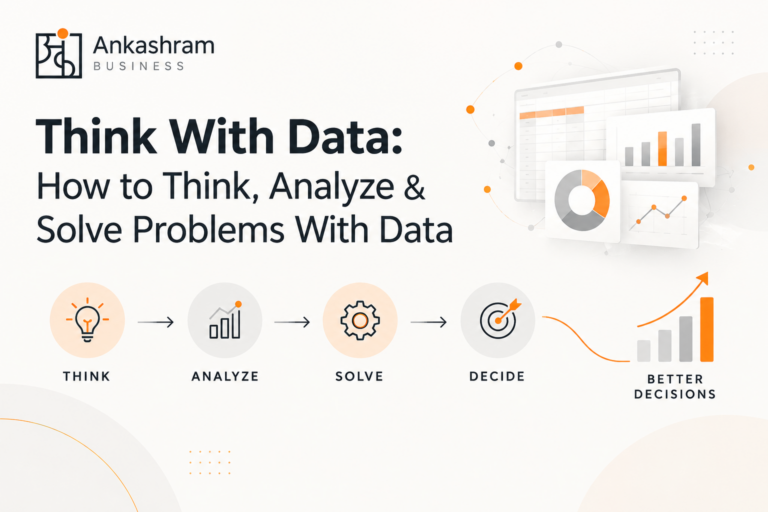
Think With Data in 2026: Why the Thinking Still Matters More Than the Tools
At some point in the last few years, “learn data analytics” turned into a checklist nobody really questioned. Learn SQL. Learn Python. Learn Power BI. Throw in a bit of machine learning so the resume looks complete. Read enough career advice and you’d start thinking getting good with data is basically a matter of collecting the right software logos.
It’s not. 2026 has made that pretty hard to ignore.
AI can write a decent SQL query from a plain-English prompt now, in about the time it takes to read this sentence. It’ll sketch a dashboard for you, summarize a messy dataset, explain a stats concept well enough that you’d pass for someone who studied it. The tools got easier — a lot easier. You’d think that would make learning data simpler too. Instead it just exposed something that was true all along and easy to miss: the tools were never really the hard part. Knowing what to actually ask them, and what to do once they answer, was.
That’s the whole idea behind Think With Data.
What it actually means
It’s tempting to read “think with data” as one of those phrases that sounds good on a course page and means almost nothing in practice. It’s not that. It’s a pretty specific set of habits, and they kick in before, during, and after you ever open a tool.
It starts with a real question instead of a vague feeling. “Sales feel off this month” isn’t something you can actually work with — there’s nowhere to go from there. “Did sales drop across every region, or just one, and did it start before or after the price change” is. That shift, from a fuzzy worry to something you can actually test, is where good analysis genuinely begins. And it’s also the part almost everyone skips, because jumping straight into a spreadsheet feels more like progress.
From there, it’s reading what the data actually shows, even the part that doesn’t agree with what you already believed walking in. It’s knowing the difference between two things that happen to move together and one that actually causes the other — ice cream sales and drowning incidents both climb in summer, and neither one’s responsible for the other, heat is. And it ends somewhere useful. Not a chart for its own sake, but a real explanation, plain enough that it doesn’t die in jargon before it reaches whoever actually needs to hear it.
Notice what’s conspicuously absent from all of that: no software named, no programming language, no specific dashboard tool. That’s not an accident. Thinking with data sits underneath all of those things. It’s the part that decides whether using a tool actually produces something useful, or just something that looks impressive and says nothing at all.
Read More: How to Improve Logical Thinking: A Practical Guide to Thinking Critically
Why the thinking outlasts the tools
Tools get swapped out. What people use for this kind of work shifts every few years, pretty reliably — what’s standard now wasn’t standard a decade back, and won’t be the default a decade from now either. Thinking clearly with evidence doesn’t go stale the same way. It’s genuinely the one piece of this whole field that survives every platform change and every new thing everyone suddenly has on their resume.
Here’s maybe the simplest way to see the difference. Someone who’s mastered a visualization tool but has no instinct for which chart actually fits the question will end up with a dashboard that’s technically flawless and still useless — full of charts nobody asked for, missing the one number that would’ve actually mattered. Someone who’s got the thinking down first, even working with a more basic toolkit, ends up producing something far more useful, simply because they knew what they were trying to find out before they opened anything at all.
You see this play out constantly in how work actually gets judged. A beautifully built analysis answering the wrong question gets quietly set aside in a meeting. A rough one that answers the real question gets acted on immediately. Nobody remembers which chart type you picked. They remember whether what you gave them helped them decide something.
There’s a second reason this matters more right now than it used to. Once a chatbot can write your query or knock out a first-draft chart in seconds, that particular skill stops being the scarce one. What’s scarce now — and getting more valuable precisely because it’s scarce — is the judgment to tell whether that AI output is actually correct, whether it’s even answering the question you meant to ask, and whether it’s solid enough to hang a real decision on. That judgment is the thinking part. No prompt hands that to you for free.
A quick example of what this looks like
Say two people get handed the exact same task: figure out why customer churn climbed last quarter.
The first one opens a dashboard tool, pulls the churn numbers, throws together a few charts showing the upward trend, maybe splits it by month, and calls it done. Technically, nothing’s wrong with it. It’s also not actually useful — all it did was restate the problem as a picture instead of a sentence.
The second person starts somewhere else entirely. They check whether the increase is happening everywhere or concentrated in one segment. They look at what else changed around the same time — a pricing tweak, a competitor’s new offer, some product change nobody flagged. They split new-customer churn from long-term churn, because those two almost always have different causes and need different fixes. By the time they’re done, they haven’t just shown that churn went up. They’ve explained why, in enough detail that someone can actually go do something about it.
Same data. Same deadline. Wildly different outcome — because one of them used tools to describe a problem, and the other used thinking to actually get underneath it.
Read More: How to Improve Logical Thinking: A Practical Guide to Thinking Critically
Why this is especially obvious in 2026
A few things happened to line up at once, and together they sharpen this whole distinction.
AI has genuinely made the mechanical side easier — writing a query, cleaning up a dataset, spitting out a first-pass chart. Useful, no argument there. But it’s also made it a lot easier to produce something that looks like a finished piece of analysis without any of the actual thinking happening underneath it. A chatbot will hand you a confident-sounding conclusion whether the logic behind it holds up or not — it has no way of knowing if you even asked the right question in the first place.
At the same time, hiring’s gotten noticeably more competitive, across pretty much every field, not just tech. More candidates than ever are walking in with the same three or four tools listed on their resume. Once everyone’s got “Power BI, SQL, Excel” sitting there, that stops meaning much. What actually separates people in an interview now is whether they can talk through how they’d approach a genuinely messy, ambiguous problem. That’s a thinking skill, not a tool skill — and it’s really hard to fake convincingly if you haven’t actually built the habit.
That’s the gap Ankashram built Think With Data to close. Not another tools course stacked on the pile of ones that already exist, but something that actually starts from the reasoning side. Tools get treated as what they genuinely are — useful, sure, but secondary to the thinking that decides how well they get used.
Read More: How to Think Like a Data Analyst (Even If You’ve Never Touched a Spreadsheet
This isn’t some anti-tool argument
To be clear, none of this is a case against learning SQL, or Python, or any particular visualization tool. Those skills still matter. Pretending otherwise would be its own mistake. This is really about sequence, not about skipping anything. Learn the thinking first, or at least alongside the tools — don’t assume it’ll just show up on its own once you’ve stacked up enough technical skills, because it usually doesn’t. Plenty of genuinely skilled, technical people never build this habit. You can see it in work that’s precise and still somehow pointless.
Tools without thinking produce busywork dressed up as output. Thinking with zero tools at all can’t get past a napkin sketch. They need each other, honestly. But only one of them is actually steering, and it’s not the tool.
What this looks like day to day
Building this skill isn’t about memorizing some framework and reciting it back on command. It’s a habit — and like most habits, it comes from doing it over and over on real, messy problems, not the kind of polished textbook example where the “right” answer is suspiciously obvious from the start.
That’s genuinely how Ankashram structures Think With Data: start with real, messy, ambiguous scenarios — the kind that actually show up at work or in an actual business case — and walk the full arc every single time. A sharp question. Honest evidence. A real conclusion. Explained in a way that doesn’t need translating. The tools come in where they’re actually needed to support that thinking, not as the headline act with the thinking tacked on afterward as an afterthought.
The people who end up genuinely good at this usually aren’t the most technically impressive person in the room. They’re the ones who ask sharper questions, stay a little suspicious of an answer that happens to confirm exactly what they expected to find, and don’t stop at “huh, interesting” when the moment actually calls for “here’s what we should do about it.”
Read More : Online vs Offline Data Analytics Course Which Is Actually Better?
Where this leaves us
Tools are going to keep changing, no question. Whatever’s considered standard software today is going to look dated in five years, the same way the standard toolkit from five years back already does. But the instinct to ask a sharp question, look at evidence honestly, and turn what you found into something someone can actually use — that doesn’t expire with the next product update. It’s just not that kind of skill.
That’s really what Think With Data is about. Not fewer tools, not some anti-technology stance. Just a plain recognition that the thinking was always doing the real work underneath everything else — and 2026, with AI quietly absorbing more and more of the mechanical side, is the year that’s become impossible to look past.
Frequently Asked Questions
Q1.Is Think With Data a coding course?
Not primarily, no. It’s built around the reasoning behind good analysis — asking the right questions, reading evidence honestly, landing on real conclusions — with just enough tool exposure to actually put that thinking into practice. It’s not structured around teaching a programming language from the ground up.
Q2.If AI can already analyze data for me, why does this skill still matter?
Because AI has no idea whether you’ve asked the right question to begin with. It’ll hand you a confidently wrong answer just as easily as a correct one, with the same tone either way. The judgment to catch that — to know what’s actually trustworthy — is exactly what this is built around, and it matters more now, not less, the more AI takes over the mechanical side.
Q3.Who’s this actually for?
Honestly, anyone who makes decisions based on information and wants to get better at it — students, working professionals, managers, marketers, analysts, all of it. It’s not reserved for people with “data” sitting in their job title.
Q4.Do I need to already know something like Excel or SQL before I start?
No. The thinking is the starting point here, with practical tool exposure built in as you go. You don’t need any prior technical background to begin.
Q5.How’s this different from a typical data analytics course?
Most courses lead with the tools and just hope the thinking develops somewhere along the way. This one leads with the thinking itself, using scenarios that actually feel real. The tools show up to support that reasoning — they’re not the main event.
Q6.Can this actually be taught, or is it just some natural talent certain people have?
It’s a learnable habit, not something you’re born with. Like any habit, it comes from deliberate, repeated practice on real problems — which is exactly how Ankashram’s built this course, rather than just hoping it develops on its own somewhere along the way.