Think With Data: How to Think, Analyze & Solve Problems With Data
Give ten people the same spreadsheet and you’ll get ten different answers. Not because the numbers changed, but because most people open excel before they’ve got a grip on what they’re actually looking for
Table of Contents
The missing link in data driven problem solving doesn’t lie in the tools, because analysts these days have more dashboards, BI platforms and automated reports to their disposal than they know what to do with. The missing link is upstream of the analysis, in thinking and preparation before opening any of those tools:
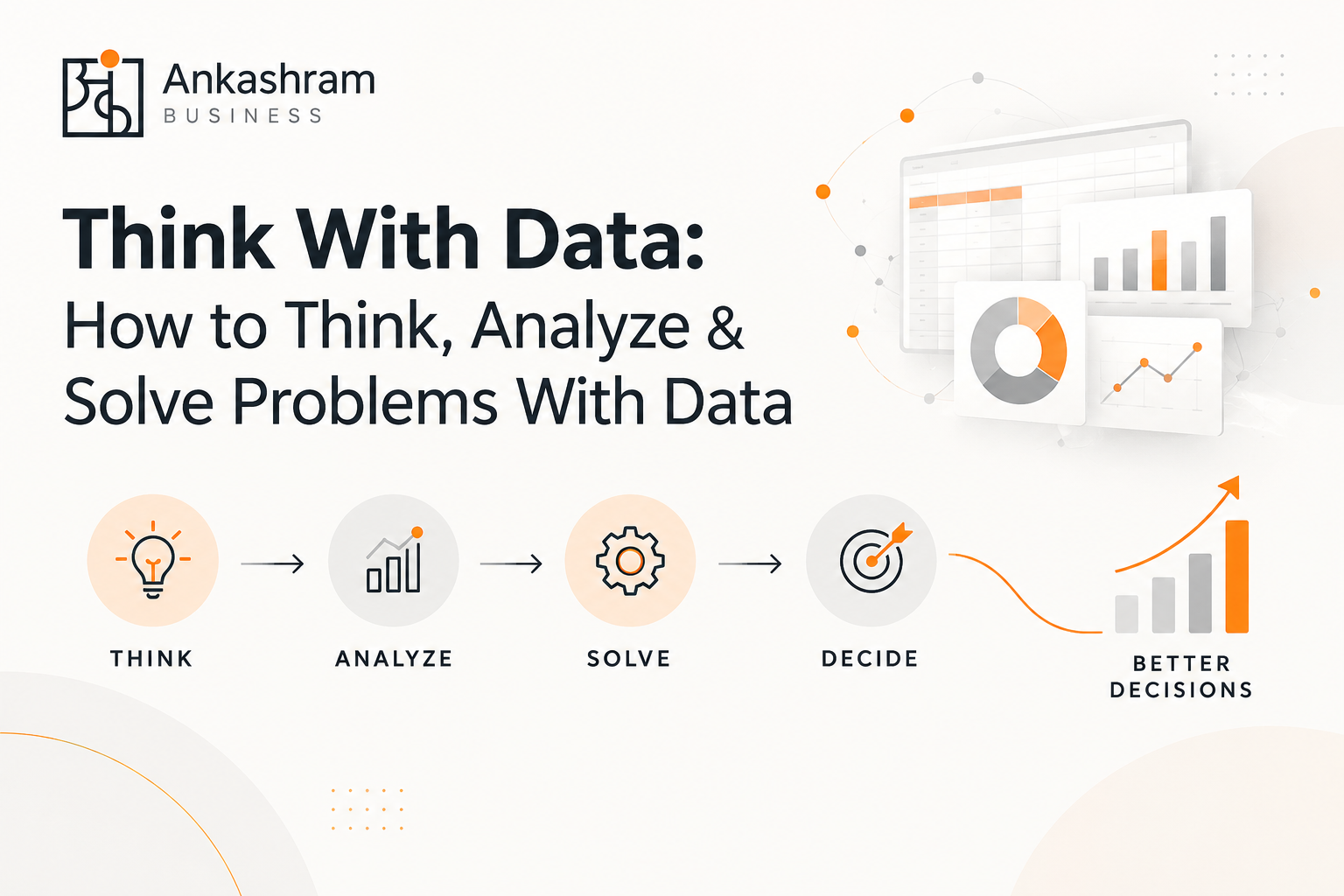
Here’s roughly the process decent analysts follow, whether they’d put it in a diagram or not
BRIEFING TREE
BUSINESS PROBLEM
│
┌─────────────────┼─────────────────┐
↓ ↓ ↓
THINK ANALYZE SOLVE
│ │ │
↓ ↓ ↓
Logical Thinking Data Analysis Problem Solving
Ask Better Interpret Data Data Decisions
Questions Avoid Bias Business Problems
│ │ │
└─────────────────┼─────────────────┘
↓
BETTER DECISIONS
Think: The Step No One Seems To Take Anymore
No one likes to put in the mental effort required to formulate a decent request for analysis when they know a spreadsheet is sitting on their desk waiting to be opened, but this is the crucial step that decides whether the next three days are going to be spent opening spreadsheets or not
Revenue was down twelve percent in March? Ask why before doing any calculations, because the ‘why’ will narrow this down into something actually answerable. Was this across the board or in a specific region? Before or after the price change took effect? Is this really abnormal or completely seasonal?
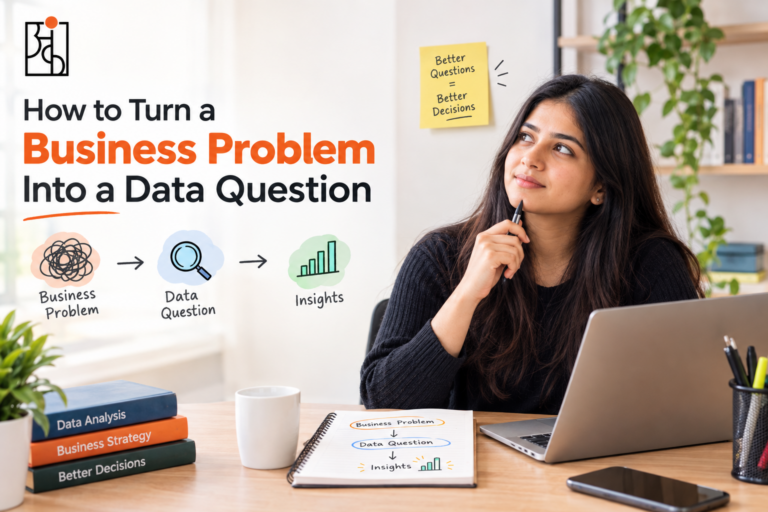
Logical thinking is thinking that doesn’t involve math, it’s constructing a hypothesis which will narrow a vague request like the one above into something concrete enough to actually find an answer to, and a decent question is something that would genuinely help you make a better business decision based on the answer. “Why are our customers dissatisfied?” is not a good question, but “had complaints about delivery times increased since we started working with this logistics company?” is an example of a question that could genuinely influence the outcome of a business decision if answered
A good test is to write the question as a single sentence and see if there is a measurable answer
Once the question has been formed, it’s on to the analysis
Analyze: Where Confirmation Bias Goes To Hide
Once a good question has been asked, the analyst goes in search of evidence, which sounds like an obvious enough task, but is actually the point where most analysis fails, quietly and subtly, because confirmation bias is hard to spot even when it’s happening
Say the logistics company example above has shown itself to be a likely culprit in the dissatisfactory change in customer complaints. Great, but did anything else change at the same time? Holidays, prices, promotions, new products, anything else that could explain the change in customer complaints? Correlation is not causation and while it’s easy enough to jump from evidence that two events occurred together to the conclusion that one caused the other, establishing causation is often much harder and requires more careful examination in order to rule out other possibilities. Interpretation is not an easy art, because it’s not about treating the evidence found as proof of whatever theory you already suspected to be true, but rather about taking the evidence seriously and finding an explanation that fits it, even if it’s not the one you were originally looking for. Confirmation bias is the belief that evidence supports your theory simply because you believe it, and the way to defend against it is to adopt the mindset that you are wrong about your theory and search for evidence that might prove it
Some practical advice when it comes to actually analyzing data:
- Make sure to cut it in more than one way before coming to a conclusion.
- Examine the size of your samples.
- Ask yourself what data you don’t have, and if it would affect the interpretation of the data you do have.
Solve: When Analysis Needs to Become a Decision
Analysis that fails to lead to action is analysis that has failed to serve its purpose. Solving business problems with data means that someone has actually taken action as a result of the analysis, and this is far more common than most people give credit for, because a lot of genuinely good analysis gets buried by a bad presentation or is poorly integrated with the overall business case
Watch the video from Ankashram.
If the logistics company is to blame for the drop in customer satisfaction, “the data confirms that” is not a solution, but “do x with that data” is
Every decision comes with opportunity costs the data analysis won’t tell you about, and this is where the decision maker has to take responsibility to choose the option that fits best with the evidence they’ve been shown without ignoring the costs and drawbacks of that choice. A good decision always considers the limitations of the evidence presented and what the evidence failed to present, and a good decision is rarely the obvious one
Decide: The Step No One Seems To Take Anymore (And Why It Matters)
The cycle doesn’t end at solve, because every decision needs to be measured for its success in the long term, and this is the step most people seem to skip, because the decision has already been made and everyone is moving on to the next issue. The purpose of data driven decision making is not a one off, it’s a loop, where the decision made feeds back into future thinking, analysis and decision making as evidence of what works and what doesn’t. A better solution is rarely the one that uses more data, it’s the one that went through all four steps of the thinking, analyzing, solving, deciding cycle.
Thinking With Data: Why This Matters
Data analysis problem solving is a process that most people see as a single step, but is actually four, because a wrong turn anywhere breaks the whole thing, and it’s very easy to do so. You can have a flawless analysis of the wrong question, excellent questions sabotaged by confirmation bias or a great conclusion that fails to turn into concrete action. Analysts who are truly good at their jobs tend to be less concerned with the statistical chops and more focused on the better questions, avoiding confirmation bias and making sure that all that effort actually results in a better business outcome
Frequently Asked Questions
Q1.What does “thinking with data” mean?
Using data to test your thinking, not to prove a point of view you’ve already decided on
Q2.How is data driven problem solving different from data analysis?
Analysis is the middle part of the whole process. Problem solving includes getting the question right beforehand and turning the finding into a decision afterwards.
Q3.How do I keep bias out of my interpretation of the data?
Go looking for what would disprove your hypothesis, cut the data more than one way and make sure your sample size actually supports the claim you’re trying to make
Q4.Do I need to be good at statistics for this?
It helps to know the difference between correlation and causation and have a rough idea about when your sample size is large enough to be meaningful, but most of these are thinking skills that apply to all parts of the analysis. Statistics is helpful, but it’s not a substitute for the other thinking skills involved.
Q5.What actually makes good analysts stand out from the rest?
Mostly the order of operations. They tend to slow down at the thinking stage before diving into the data, and also make sure to come back and examine the decision as a whole to see if it has had the desired consequences.
Q6.What’s one easy way to start doing this myself?
Next time a problem comes your way, write the question as a single sentence with a measurable answer before you actually touch any data.