Online vs Offline Data Analytics Course Which Is Actually Better?
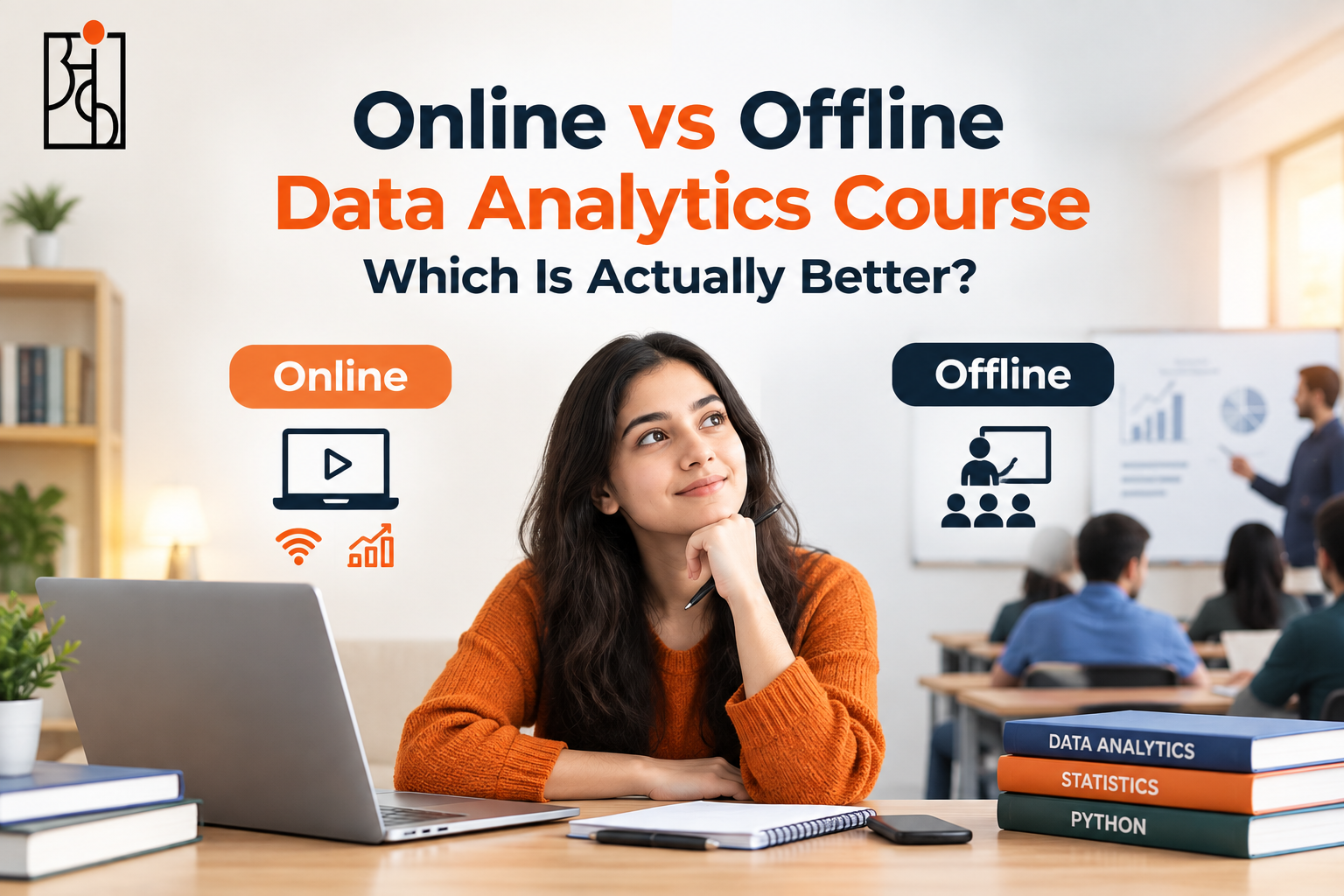
Online vs Offline Data Analytics Course is an important choice for anyone planning to build a career in data analytics. The right learning format can depend on your budget, schedule, learning style, need for guidance, and career goals. Vikram had two browser tabs open and a decision he’d been putting off for three weeks. One tab showed a well-reviewed online data analytics course — self-paced, ₹35,000, and available whenever he wanted. The other showed a classroom program at an institute twenty minutes from his flat — fixed schedule, ₹85,000, and in-person from day one. His cousin had taken the online route and landed a job in four months. A former colleague had chosen the offline route and believed the in-person accountability was the reason she actually completed the course instead of quietly abandoning it around week six. So, which option should you choose? In this guide, we’ll compare online vs offline data analytics courses based on flexibility, cost, practical learning, instructor support, accountability, networking, and career preparation.
Table of Contents
What an Online Data Analytics Course Actually Looks Like
“Online data analytics course” covers a genuinely wide range of formats, and lumping them all together is where a lot of people get their expectations wrong before they even enroll. Self-paced courses — pre-recorded video, work through it whenever — sit at one end, offering maximum flexibility and, usually, the lowest price, but demanding real self-discipline since there’s no fixed class time forcing progress. Live, cohort-based online programs sit closer to the middle, with scheduled sessions, a instructor actually present in real time, and classmates moving through the material together, which recreates some of the structure people associate with a physical classroom while still saving on commute time and, often, tuition.
The genuine strength of the online format is flexibility that actually respects a real schedule — someone working a full-time job, or living somewhere without a strong local training market, can access exactly the same course content as someone in a major city, on their own timeline. The genuine weakness is that this flexibility only pays off for people who can actually manage their own time well, and a lot of people, honestly, can’t yet, especially early in a new skill they haven’t built confidence in.
What an Offline Data Analytics Course Actually Looks Like
An offline data analytics course means physical classroom instruction — a fixed schedule, an instructor in the room, classmates sitting next to you rather than in a chat window. This format tends to concentrate in major cities with an established training ecosystem, which is itself a real constraint for anyone outside those markets who’d have to relocate or commute significantly just to attend.
What offline training buys, beyond the content itself, is structural accountability that’s genuinely hard to replicate online. Showing up to a physical room at a set time creates a kind of commitment that a “watch whenever you want” video library simply doesn’t, and for learners who know themselves well enough to recognize that self-paced learning has failed them before, that structural pressure is worth real money on its own. In-person mentorship also tends to catch confusion faster — an instructor watching someone struggle with a SQL query in real time can intervene immediately, in a way that’s harder to replicate through a forum post or a scheduled office-hours call days later.
Choosing a Data Analytics Course for Beginners Specifically
The online-versus-offline question actually shifts depending on where someone’s starting from, and it’s worth addressing beginners separately from someone already comfortable with spreadsheets and basic logic.
Someone with zero technical background tends to benefit more from offline structure, or at minimum a live, cohort-based online program rather than a fully self-paced one, simply because the earliest stage of learning something genuinely new is where people most often give up quietly, alone, without anyone noticing they’ve stalled. A completely self-directed beginner course works beautifully for someone who’s already proven to themselves they can finish something difficult without external structure. It’s a genuine risk for someone who hasn’t built that discipline yet, and there’s no shame in knowing that about yourself honestly before choosing a format.
That said, cost is a real factor specifically for beginners testing genuine interest rather than committing fully. Starting with a low-cost or free online resource to confirm the field actually interests you, before spending ₹80,000 or more on an offline program, is a reasonable, low-risk way to avoid a expensive false start. The right sequencing for a lot of beginners is actually both — a cheap online taste test first, then a more structured, possibly offline commitment once genuine interest is confirmed.
Online vs Offline Data Analytics Course: A Direct Comparison
Cost tends to favor online options meaningfully, since offline programs carry real overhead — classroom space, in-person instructor time, physical materials — that gets reflected directly in tuition. The gap isn’t universal, but it’s common enough that budget-conscious learners lean online by default, and reasonably so.
Flexibility clearly favors online formats too, particularly self-paced ones, for anyone juggling a full-time job, family responsibilities, or a schedule that simply doesn’t accommodate fixed class times. Offline programs demand a level of schedule commitment that not everyone can actually make, regardless of how motivated they are.
Accountability and structure tend to favor offline formats, or at minimum live cohort-based online programs over fully self-paced ones. The physical (or scheduled, real-time) presence of an instructor and classmates creates a completion pressure that a purely self-paced video library doesn’t replicate well, and completion rates for genuinely self-paced online courses are, honestly, not great across the industry as a whole.
Hands-on practice and immediate feedback favor offline environments somewhat, mainly because real-time correction happens faster in person than through asynchronous online channels. This gap has narrowed considerably as online programs have improved their live instruction and feedback loops, but it hasn’t closed entirely, particularly for anyone who learns best through immediate back-and-forth rather than written feedback delivered hours or days later.
Networking and local market connections tend to favor offline programs, especially ones run by institutes with genuine placement relationships in a specific city’s job market. Online programs increasingly offer their own networking through cohort communities and virtual events, but a physical classroom in a city with an active hiring market still tends to produce more organic, immediate local connections than a fully remote cohort spread across different cities and time zones.
Read More: How to Improve Logical Thinking: A Practical Guide to Thinking Critically
The Hybrid Option Nobody Mentions Enough
A genuine middle path exists between purely online and purely offline, and it’s worth naming directly since a lot of comparison guides skip past it entirely. Hybrid programs — recorded or live online instruction combined with periodic in-person sessions, workshops, or mentorship days — try to capture the flexibility of online learning alongside some of the accountability and networking benefits of a physical classroom.
This isn’t automatically the best of both worlds; done poorly, a hybrid program ends up with the scheduling rigidity of offline training and the impersonal distance of online learning at the same time, satisfying neither need particularly well. Done well, though, it genuinely suits a specific kind of learner — someone who wants the cost savings and schedule flexibility of online content for the bulk of their learning, but knows they’ll benefit from a handful of fixed, in-person touchpoints to stay accountable and build real connections with instructors and classmates. If a hybrid option is available and reasonably priced, it’s worth serious consideration rather than defaulting straight to a purely online or purely offline choice without checking whether a middle path actually fits better.
Read More : 10 Best Data Analytics Tools for Data Analysts in 2026: A Practical Guide
Which Is Better, Online or Offline Data Analytics Course? The Honest Answer
Here’s the honest answer, without hedging it into meaninglessness: for someone with strong self-discipline, a real budget constraint, and a schedule that doesn’t accommodate fixed class times, online is better, full stop, and paying more for an offline program in that situation would be paying for structure that person doesn’t actually need. For someone who knows their own follow-through has failed them before in self-directed learning, who has the budget and schedule flexibility to attend in person, and who values the networking and immediate feedback a physical classroom provides, offline is genuinely worth the premium, and choosing the cheaper online option purely to save money would likely mean a real risk of not finishing at all.
The mistake most people make in this decision isn’t picking the “wrong” format in some absolute sense — it’s picking a format based on price or reputation alone, without being honest about their own learning history and actual constraints. Vikram, for what it’s worth, went with the live cohort-based online option once he’d actually named his own pattern out loud — he’d finished every structured, deadline-driven project he’d ever started, and abandoned every purely self-directed one, which made the “live” part of the decision considerably more important than the “online” part ever was.
What Actually Makes a Course the Best Data Analytics Course for You
Format matters less than most people assume once you get past the online-versus-offline question, and the syllabus underneath either format matters more. The best data analytics course, regardless of delivery format, covers spreadsheets and SQL in real depth rather than surface-level syntax, includes genuine statistics training scoped to what an entry-level role actually needs rather than academic theory, builds toward at least one real, messy capstone project rather than a string of pre-cleaned tutorial exercises, and requires learners to actually present findings out loud at some point, since communication skill matters as much as technical skill in the real job either format is training someone for.
A cheap online course with a real capstone and genuine project feedback can outperform an expensive offline program that’s light on hands-on practice, and the reverse holds just as true. The delivery format is a container. What’s actually inside that container — the syllabus, the feedback loop, the accountability structure — determines whether a specific course, online or offline, deserves to be called the best option for a specific learner’s goals.
Read More: How to Improve Logical Thinking: A Practical Guide to Thinking Critically
Data Analytics Training Doesn’t End When the Course Does
Whichever format gets chosen, it’s worth being honest that a single course — online or offline — is the beginning of data analytics training, not the end of it. The field moves quickly enough that genuine competency comes from continued practice well past a course’s final module: real projects taken on afterward, contributions to open datasets, staying current with how tools and expectations shift year to year.
This matters specifically for the online-versus-offline decision because it changes what “finishing” a course actually means. An offline program’s fixed end date creates a natural, sometimes false sense of completion — the certificate gets handed over, and it’s easy to treat the learning as done. Online, self-paced formats sometimes handle this better by design, since there’s no graduation ceremony marking an artificial endpoint, and continued self-directed practice tends to blend more naturally into what the course itself already looked like. Neither format inherently solves this problem on its own; it’s worth building the habit of ongoing practice deliberately, regardless of which format taught the fundamentals.
Read More: How to Think Like a Data Analyst (Even If You’ve Never Touched a Spreadsheet
How to Actually Decide for Your Own Situation
Start by being honest about your own track record with self-directed learning, since that single factor probably predicts your success with either format more than anything else on this list. Check your actual budget against real numbers rather than a vague sense of what feels affordable — online options often run meaningfully cheaper, but not always enough to justify the format alone if offline genuinely suits your learning style better. Consider your schedule honestly, since a fixed-time offline program that conflicts with a full-time job isn’t a viable option no matter how much you’d otherwise prefer it. And weigh how much you actually value in-person networking and immediate feedback against how much you value flexibility and lower cost, since these two priorities genuinely pull in different directions and there’s no format that maximizes both simultaneously.
None of this is really a decision with a universally right answer waiting to be discovered. It’s a decision about matching a format to a specific person’s actual constraints and learning history, and the people who choose well are the ones who’ve actually done that matching honestly, rather than picking whichever option sounded more impressive to say out loud.
Read More : How to Get a Data Analyst Job: What Actually Moves the Needle
Frequently Asked Questions
Q1.So which is better, online or offline data analytics course, if I genuinely can’t decide?
Start with whichever one you can actually try at low cost or low commitment first — a free online module, or a single trial class at a local institute if one’s offered. Real experience with a small taste of each format tends to answer this question faster and more honestly than reading another comparison article, this one included.
Q2.Is an online data analytics course actually respected by employers, or do they prefer offline credentials?
Employers overwhelmingly care about demonstrated skill and real project work more than the delivery format the training happened through. A strong portfolio from an online course beats a weak one from an offline program every time — the format is rarely, if ever, the deciding factor in a hiring decision on its own.
Q3.What’s the biggest mistake people make when choosing between online and offline data analytics training?
Choosing based on price or reputation alone, without honestly assessing their own track record with self-directed learning. Someone who’s abandoned every self-paced course they’ve ever started is likely to repeat that pattern with an expensive online program just as easily as a cheap one, and the fix isn’t a better online course — it’s a format with more built-in structure.
Q4.Can a data analytics course for beginners work well fully online, or is in-person always better for someone starting from zero?
Fully online can work well for beginners, particularly live, cohort-based formats with real deadlines and instructor interaction — it’s specifically the fully self-paced, no-structure version of online learning that tends to struggle for absolute beginners, not the online format as a whole.
Q5.Is it worth paying significantly more for an offline data analytics course if a cheaper online option covers the same syllabus?
It depends entirely on whether the extra cost is actually buying something you personally need — accountability, in-person networking, immediate feedback — or just buying the same content in a more expensive container. If the syllabus and project quality are genuinely comparable, the premium only makes sense if the format itself solves a real problem you have with self-directed learning.
Q6 Are you looking for a Data Analyst course in Bhopal?
If you are looking for a Data Analyst course in Bhopal, Ankashram offers data analytics training with practical, industry-focused learning. Ankashram also provides online data analytics courses, making it possible to learn from anywhere.