How Humans Analyze: The 4-Step Mind Model
Here’s a question worth sitting with for a second: are you an analyst?
Table of Contents
Most people’s gut answer is no. Ask a room full of working professionals that question and you’ll usually get 85–90% saying no. Only a small handful claim the title. But that answer is almost always wrong — and not in a soft, “everyone’s special” way. It’s wrong in a very literal, mechanical sense. If you’ve ever compared two phones before buying one, picked a restaurant for a family dinner, or decided which job offer to take, you’ve already run a full analysis. You just didn’t call it that.
That’s the idea behind what we can call the 4-Step Mind Model — a simple description of how humans actually analyze things, whether they realize it or not. It’s not some corporate framework someone invented and forced onto the way people think. It’s closer to naming something your brain already does automatically, every day, usually without you noticing the structure underneath.
The Four Steps, in Plain Language
Think about the last time you bought a phone, a car, or even just ordered food for the family on a weekend. Without realizing it, you probably moved through four distinct stages.
Define. Before you compare anything, you decide what you’re actually solving for. Buying a phone isn’t one decision — it’s several possible ones wearing the same outfit. Are you after a great camera, or do you mainly care about battery life lasting a full day of travel? Until that’s clear, nothing else that follows makes much sense.
Collect. Once you know what you’re deciding, you go gather information relevant to that specific question. YouTube reviews, spec sheets, prices, a friend’s blunt opinion over text. This is the step that feels the most like “doing research,” and it’s also the step everything downstream depends on most heavily.
Evaluate. Now you weigh the options against your actual constraints. Great mileage sounds nice, but can you actually afford the monthly payment? A phone with a stunning camera doesn’t matter much if it dies by 3pm every day. This is where raw information turns into judgment.
Decide. Finally, you act. You buy it, or you walk away and keep looking. The analysis isn’t complete until it produces an actual decision — stopping at “interesting options” without committing isn’t analysis, it’s just browsing.
Define → Collect → Evaluate → Decide. That loop is analysis, whether you’re buying a car or running a business review. The structure doesn’t change; only the stakes do.
Why This Model Actually Matters
It would be easy to treat this as a cute way of saying “everyone’s secretly an analyst,” pat yourself on the back, and move on. But the real value of naming the model is that it shows exactly where things go wrong when a real analysis — the kind that affects a business, not just a dinner order — actually fails.
And overwhelmingly, when something goes wrong, it’s not the Evaluate or Decide steps that caused it. It’s Collect. If what goes into your analysis is wrong, nothing that happens afterward can save you. This is the oldest idea in data work, usually summarized in four blunt words: garbage in, garbage out.
A few ordinary examples make this uncomfortably easy to picture. A review says a car gets 25 km/L; the real figure turns out to be 10, and suddenly the monthly fuel budget doesn’t work — not because the decision-making was flawed, but because the input feeding it was wrong from the start. A food delivery pin drops one street over, and dinner shows up at a stranger’s door. In a plant operations setting, feedstock gets logged as 20,000 in a field meant for tonnage — when the real figure was 20 — and every dashboard and target downstream is now built on a number that’s off by a factor of a thousand.
None of these are exotic failures. They’re small, ordinary data-entry slips. But because Collect sits right at the base of the whole model, a flawed input doesn’t stay contained — it quietly reshapes everything that happens after it.
When This Goes Wrong at Scale, It Gets Expensive
It’s tempting to assume this kind of thing only matters for small, everyday decisions, and that serious organizations with serious tools are immune. History says otherwise, and some of the examples are genuinely startling once you see the actual numbers.
Company A, a space agency, lost a spacecraft worth roughly $125 million because one engineering team sent thrust data in pound-force while the navigation team was expecting newtons — a unit mismatch that sent the craft too low into a planet’s atmosphere.
Company B, a trading firm, saw a trader intend to sell one share at a high price; instead, the order was entered as over 600,000 shares at a fraction of that price — many times more shares than the company actually had in existence — triggering a loss north of $340 million.
Company C, a major retailer expanding into a new country, collapsed under a write-down north of $5 billion, partly because product data for roughly 75,000 items was entered with no consistent standard — inches mixed with centimeters, currencies mismatched — leaving only about 30% of the data actually accurate.
Company D, a global bank, traced part of a multi-billion-dollar trading loss back to a risk model built on manually copy-pasted spreadsheets, where one formula used SUM instead of AVERAGE and quietly halved the risk being reported.
None of these disasters involved some exotic technological failure. Every single one of them began with one unchecked entry, one unclear unit, one copy-pasted formula nobody double-checked. The Collect step failed quietly, and Evaluate and Decide simply inherited that failure without any way of catching it.
Why AI Doesn’t Fix This Problem
There’s a tempting, comforting myth going around right now: now that we have AI and smart dashboards, human entry errors stop mattering, because the system will just auto-correct them.
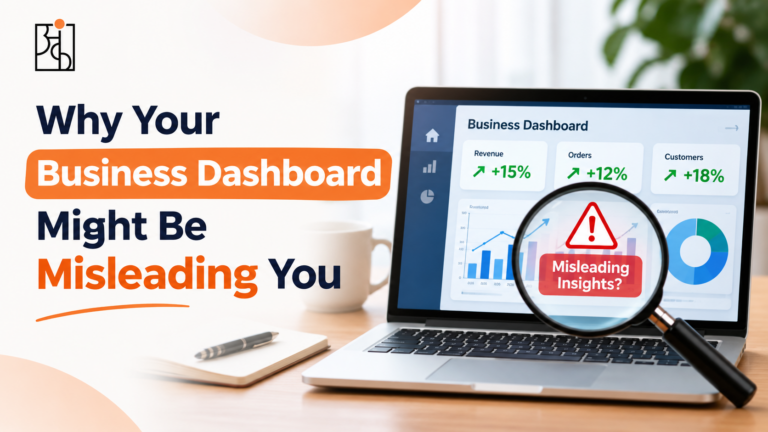
It won’t. A tool like an AI model, a visualization dashboard, or a monitoring platform processes exactly what it’s given — nothing more, nothing magically corrected along the way. Mixed date formats, swapped units, missing metadata — none of that gets quietly fixed behind the scenes. What you get instead is something arguably more dangerous than an obvious error: a beautifully formatted, perfectly confident report that is completely wrong, with no visual indication that anything’s off.
That’s a genuinely dangerous combination, because leadership tends to trust a clean-looking dashboard more than a messy spreadsheet, even when the dashboard is the one quietly lying. If the sanity of the input is missing, the dashboard doesn’t correct for that — it just presents a false truth with excellent formatting.
So What Actually Fixes This? Habits, Not More Software
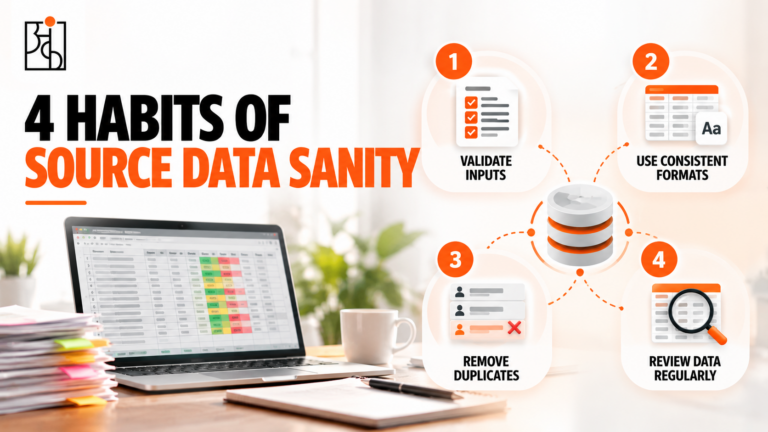
The fix for this isn’t a smarter tool. It’s a handful of unglamorous habits applied consistently at the point where data actually enters a system — the Collect step, before anything downstream has a chance to go wrong.
Unit literacy-
Build the unit directly into the field itself — something like “Feedstock_In (T)” instead of a generic field anyone could misread — so nobody has to guess or assume.
– Bounds checking. Agree on a valid range for every parameter ahead of time. A digester level should sit somewhere between 0 and 10 meters, not 7,000. A pH reading belongs between 0 and 14, not 72. Runtime in a single day can’t exceed 24 hours. Building these limits into the data entry process catches an obviously wrong number before it ever reaches a dashboard.
– Consistency. One date format. Dropdown menus for site names instead of free-text fields where “Site Alpha” and “site alpha” quietly become two different entries in a system that treats text literally.
– Ownership. Every field needs someone responsible for it — someone who knows the format, tells the people entering data what’s expected, and actually checks compliance instead of assuming it’s fine.
None of this requires new, complicated software layered on top of what already exists. It requires people treating data entry as something other than disposable clerical work — because in reality, it’s the seed that an entire downstream system of automated decisions grows out of.
The Real Takeaway
Everyone running a business, managing a team, or just living a normal life with decisions to make is already an analyst, whether they’ve ever used that word about themselves or not. The Define → Collect → Evaluate → Decide loop runs constantly, mostly invisibly. What separates a good outcome from an expensive disaster usually isn’t some advanced analytical technique applied at the end. It’s whether the Collect step — the facts the whole thing stands on — was actually solid to begin with.
A single data entry, logged carelessly at the source, can ripple forward into tomorrow’s targets, a team’s automated workflows, or a leadership team’s confidently wrong decision. That’s not a hypothetical. It’s the pattern behind four very different organizations’ very public, very expensive mistakes — different industries, one shared root cause.
This is exactly the kind of thinking Ankashram builds its data culture sessions around — not abstract theory, but the very real, very human habits that determine whether an organization’s data can actually be trusted once it reaches a dashboard. Treat every entry like it matters, because somewhere downstream, for someone, it eventually will.
Frequently Asked Questions
Q1.What is the 4-Step Mind Model in data analysis?
It’s a simple framework describing how humans naturally analyze any decision: Define the actual question, Collect relevant facts, Evaluate those facts against real constraints, and Decide — act on the conclusion. It applies equally to buying a phone and to running a business analysis.
Q2.Why is the “Collect” step considered the most important?
Because every later step depends entirely on it. If the information gathered at this stage is wrong — a unit mismatch, a typo, an inconsistent format — no amount of careful evaluation afterward can correct it. This is the root of the “garbage in, garbage out” principle.
Q3.Can AI or automated dashboards fix bad data automatically?
No. AI tools and dashboards process exactly what they’re given, with no built-in ability to detect that a number is implausible or a unit is wrong unless specifically designed to check for it. A flawed input often produces a confidently wrong, well-formatted output, which can be more dangerous than an obvious error because it looks trustworthy.
Q4.What are some real examples of bad data causing major losses?
Well-documented cases span a range of industries: a space agency lost a spacecraft over a unit mismatch, a trading firm suffered a major loss from a mistaken order quantity, a major retailer wrote down billions partly due to inconsistent product data, and a global bank understated its risk due to a spreadsheet formula error. Each began with one small, unchecked entry.
Q5.How can a team prevent these kinds of data entry errors?
Four habits help the most: building units directly into field names, setting valid ranges for every parameter, standardizing formats so variations can’t creep in, and assigning clear ownership for each data field so someone’s actually responsible for checking it.
Q6.Is this framework only relevant for technical or data-focused roles?
No. Since the 4-Step Mind Model describes how people naturally make any decision, it applies to virtually every role — operations, HR, management, even everyday personal choices. Anyone who collects information before deciding something is already using it.