Data Analytics Trends in 2026: What’s Actually Changing, Not Just What’s Trending
A few years ago, a dashboard that updated once a day felt modern. A team would check it every morning, note what had changed since yesterday, and make decisions based on numbers that were, by the time anyone looked at them, already twelve hours old. That gap between when something happened and when a business actually knew about it used to be treated as an acceptable cost of doing analytics at all. It isn’t anymore, and the reason has less to do with any single flashy technology than with something quieter: leadership across most industries has simply run out of patience for slow answers, and the tools have finally caught up enough to make that impatience justified rather than unreasonable.
Table of Contents
That shift in tolerance is arguably the real story behind 2026’s data analytics trends, more than any individual tool or acronym making the rounds at a conference. A handful of genuinely distinct developments — in AI, in infrastructure, in governance — are converging at the same moment, and the organizations handling this well have stopped treating them as three separate initiatives and started running them as one connected shift in how analytics actually works.
Key Data Analytics Trends in 2026
| Trend | What is changing? | Business impact |
|---|---|---|
| Agentic Analytics | AI can monitor and act on data | Faster decisions |
| Natural Language Querying | Users can ask questions in plain language | Easier data access |
| Real-Time Analytics | Businesses analyze data as it happens | Faster response |
| Data Governance | Trust and security become essential | More reliable insights |
| Semantic Layer | Consistent business definitions | Better data accuracy |
Agentic Analytics: From Dashboards to Systems That Act
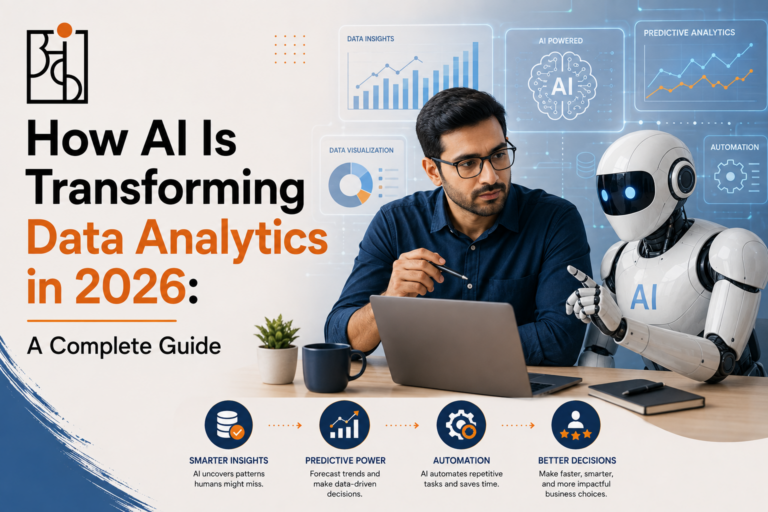
The single most discussed theme heading into 2026, including at major industry gatherings like Gartner’s own Data & Analytics Summit, is what’s being called agentic or autonomous analytics — AI systems that don’t just wait for someone to ask a question, but actively scan data on their own, flag anomalies, and in some cases suggest or even take a next step without a human prompting each individual query first.
This is a genuinely different posture from the AI-powered analytics of the past few years, which mostly meant faster dashboards and smarter charts still waiting for someone to open them. An agentic system monitoring sales data doesn’t wait for Monday’s meeting to notice a regional dip — it flags the anomaly the moment it crosses a meaningful threshold, pulls together the likely contributing factors on its own, and surfaces a summary before anyone thought to go looking. The analyst’s role shifts in response, from someone who runs the query to someone who reviews, questions, and directs what these systems are actually doing, which is a meaningfully different skill than the one most analytics training has focused on until now.
It’s worth being honest that this shift is still uneven in practice. Plenty of companies are experimenting with agentic tools in a limited, closely supervised way rather than handing over real decision-making, and that caution is reasonable — an autonomous system that confidently flags the wrong anomaly, or takes an action based on a misread pattern, can cause real damage faster than a human ever would have. The trend is real. The maturity of most organizations actually deploying it responsibly is still catching up to the hype surrounding it.
Natural Language Querying Is Finally Good Enough to Matter
For years, the promise of “just ask your data a question in plain English” existed mostly as a demo that worked well on stage and fell apart the moment a real user typed something slightly ambiguous into it. That gap has narrowed considerably heading into 2026, largely because the large language models underneath these tools crossed a real reliability threshold for production use rather than just impressive-looking prototypes.
The practical effect shows up most clearly for people who were never going to learn SQL in the first place. A marketing manager typing “show me which campaigns drove the most repeat purchases last quarter” and getting back a genuinely correct, well-formed chart represents a real widening of who can actually interact with a company’s data directly, rather than routing every question through an analyst who becomes a bottleneck for anything more specific than a pre-built dashboard already covers.
This doesn’t eliminate the need for trained analysts — if anything, it changes what they’re needed for. Someone still has to build and maintain the underlying data structure that makes a natural-language query return a trustworthy answer instead of a confidently wrong one, and someone still has to catch the moment a plain-language question gets subtly misinterpreted by the system answering it. The bottleneck is moving up a level, from “who can write the query” to “who can make sure the whole system is actually built to be queried safely by people who don’t know what a join is.”
Real-Time Analytics Stops Being the Exception
Streaming and real-time analytics have been on trend lists for a few years running, but 2026 marks something closer to a genuine tipping point rather than another incremental step. Edge computing — running analysis physically close to where data actually gets generated, rather than shipping everything back to a central server first — has gotten cheap enough that it’s become a straightforward purchasing decision for a lot of companies rather than a major architectural gamble reserved for a handful of tech giants.
The practical shift this enables is significant: a retailer can adjust pricing or restock alerts based on what’s happening in a specific store right now, rather than waiting for an overnight batch job to process yesterday’s transactions. A manufacturing line can flag a quality issue the moment a sensor reading drifts out of range, instead of discovering the problem in a weekly quality report after a full week of defective output has already shipped. The businesses adopting this well aren’t just running faster versions of their old batch reports — they’re rethinking which decisions actually benefit from being made in the moment versus which ones genuinely don’t need that speed, since not every business question actually requires real-time answers, and treating everything as urgent just because the infrastructure now allows it is its own kind of mistake.
Read More: How to Improve Logical Thinking: A Practical Guide to Thinking Critically
Governance and Trust Move From Afterthought to Design Requirement
As analytics systems get faster and more autonomous, the question of whether their outputs can actually be trusted has become considerably more urgent, not less. Regulatory pressure has tightened meaningfully around the world, and privacy frameworks that used to feel like a compliance checkbox handled once a year are increasingly built into how data systems get designed from the start, rather than bolted on afterward.
Zero-trust access controls — treating every request for data as something to verify rather than assuming internal access is automatically safe — have moved from a specialized security concern into something closer to a baseline expectation for any serious data platform. This matters more as agentic systems get more autonomy, since a system capable of acting on data without a human double-checking every step also needs correspondingly tighter guardrails around what data it can actually touch and what actions it’s allowed to take on its own.
There’s a genuine tension sitting underneath this trend that’s worth naming honestly. The same year that’s pushing analytics toward more autonomy and speed is also the year demanding tighter governance and more careful trust-verification at every step. These aren’t contradictory goals exactly, but they do pull in different directions operationally, and the organizations handling 2026 well are the ones treating governance as something that has to scale alongside the AI capability, not as a separate, slower-moving track that inevitably lags behind it.
Read More: How to Think Like a Data Analyst (Even If You’ve Never Touched a Spreadsheet
The Rise of the Semantic Layer
A quieter but genuinely important trend sits underneath a lot of the flashier ones: renewed attention to what’s being called the semantic layer, essentially a shared, consistent definition of what specific business terms actually mean across an entire organization’s data systems. This sounds almost too basic to be a trend, and that’s exactly why it’s been overlooked for years while more exciting technology got the attention.
The problem it solves is genuinely common and genuinely expensive when left unaddressed: two departments both reporting “revenue” using slightly different definitions, producing two different numbers for supposedly the same thing, and nobody noticing until a meeting grinds to a halt over which number is actually correct. As AI-driven and agentic tools pull data from more sources automatically, this kind of definitional drift becomes considerably more dangerous, since a system confidently generating an answer from inconsistent underlying definitions produces a wrong answer with exactly the same confident tone as a right one. Getting the semantic layer right — consistent, well-documented, actually enforced across systems — has become a genuine prerequisite for trusting anything more advanced built on top of it, rather than a nice-to-have documentation exercise nobody prioritizes.
Read More : Comic by Ankashram – Ask Tough Questions with Your Data Analyst
What This Actually Means for Anyone Working in the Field
For individual analysts, these trends add up to a fairly specific shift in what actually gets valued day to day. Hiring conversations increasingly weight demonstrated projects and practical, hands-on experience considerably more heavily than a stack of certifications, since certificates say someone sat through material while a real project says someone actually built something and made it work. Comfort working alongside AI tools — reviewing and directing what an AI assistant produces rather than either blindly trusting it or refusing to use it at all — has become close to a baseline expectation rather than a differentiating skill.
There’s also a growing expectation that analysts understand at least the basics of how the systems they’re working with are actually built, not just how to query them. Someone who think with data why a semantic layer matters, or why an agentic system’s anomaly detection might be flagging false positives, brings considerably more value than someone who can only interact with these tools as opaque black boxes producing answers to trust or not trust on faith.
Read More : How to Get a Data Analyst Job: What Actually Moves the Needle
Skills Data Analysts Need in 2026
| Skill | Why it matters |
|---|---|
| SQL | Working with business databases |
| Data Visualization | Communicating insights clearly |
| AI Tools | Working effectively with AI-assisted analytics |
| Critical Thinking | Questioning and validating results |
| Data Governance | Understanding data quality and trust |
| Business Understanding | Connecting analysis to decisions |
A Note of Caution Worth Keeping in Mind
Every year produces its own crop of trend lists, and a healthy skepticism toward some of the more breathless framing is worth holding onto. Not every organization needs agentic analytics deployed at full autonomy this year, and plenty of genuinely successful data teams will keep running mostly on solid fundamentals — clean data, clear definitions, well-built dashboards, and analysts who communicate findings clearly — while adopting the newer capabilities gradually and carefully rather than racing to implement every trend simultaneously.
The organizations that tend to get burned in a year like this are usually the ones chasing the appearance of being cutting-edge without the underlying discipline to support it — deploying an autonomous system on top of genuinely messy, poorly governed data, for instance, which mostly just means bad decisions get made with more confidence and less human oversight than before. The trends covered here are real and worth understanding. Adopting them responsibly, at a pace that actually matches an organization’s underlying data maturity, matters considerably more than being first.
Read More: Basic Excel Formulas for Data Analysis (That You’ll Actually Use)
Frequently Asked Questions
Q1.Is agentic analytics actually being used in real companies yet, or is it still mostly hype?
Both, depending on the organization. Genuine deployments exist, but most companies are still in a cautious, closely supervised experimentation phase rather than handing over full autonomous decision-making. The underlying technology has matured quickly; organizational trust and governance are still catching up.
Q2.Do these trends mean data analysts will need to learn to code more heavily?
Not necessarily code in the traditional sense, but understanding how the systems they work with are actually built — including the logic behind an AI agent’s outputs — is becoming more valuable than pure query-writing skill alone. The exact technical depth needed varies a lot by role and company.
Q3.Should a smaller business worry about falling behind if it isn’t using agentic AI or real-time analytics yet?
Not urgently. Plenty of the value in analytics still comes from fundamentals — clean, well-governed data and clear communication of findings — that matter regardless of which advanced tools sit on top of them. Adopting newer capabilities gradually, once the fundamentals are solid, tends to work out better than rushing to match a trend list.
Q4.What’s the biggest risk in adopting these 2026 trends too quickly?
Deploying faster, more autonomous tools on top of data that isn’t well governed or consistently defined in the first place. This doesn’t reduce risk, it just means bad decisions get made with more speed and confidence than before, which is often worse than the slower, more cautious process it replaced.