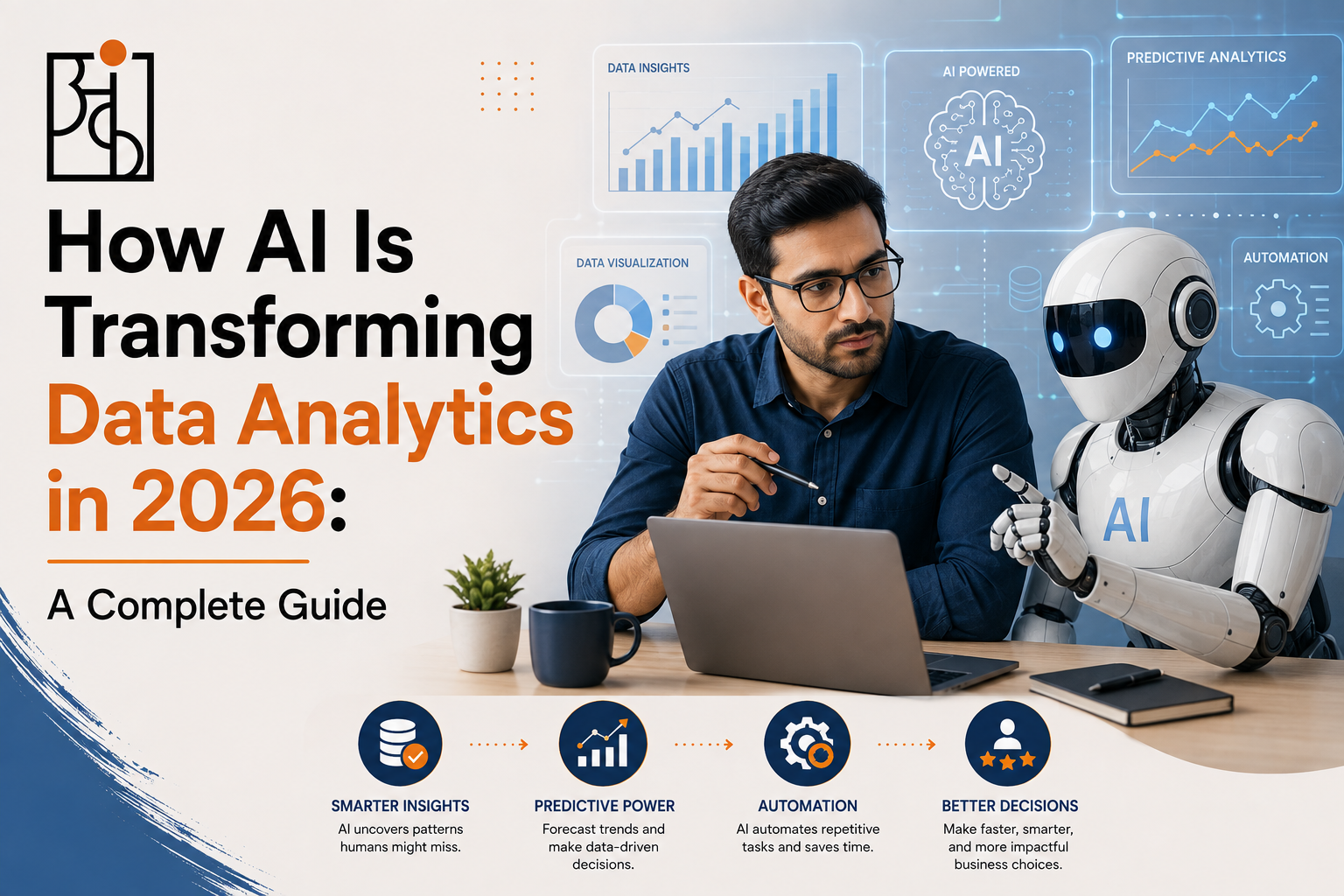
How AI Is Transforming Data Analytics in 2026: A Complete Guide
Know about AI-Powered Analytics Through One End-to-End Business Case Study
Imagine you’re the Head of Data Analytics at FreshCart, a fast-growing online grocery delivery company operating across Mumbai, Delhi, Bengaluru, Hyderabad, and Pune. Every Monday morning, the leadership team gathers around one dashboard.
Table of Contents
The CEO asks only one question ?
We’re spending more on marketing every month. Why are our revenues falling?
The marketing team blames pricing. Operations blames logistics. Finance blames discounts. Customer Success blames product quality. Everyone has an opinion.No one has an answer.
Five years ago, solving this problem would have taken a team of analysts several days. They would export reports from Shopify, Google Analytics, Meta Ads, CRM systems, warehouse software, and customer support platforms. They would spend hours cleaning spreadsheets before writing SQL queries, building dashboards, and preparing presentations.
In 2026, Artificial Intelligence has completely changed this workflow.
Instead of replacing analysts, AI acts as an intelligent partner that accelerates every stage of analytics—from data preparation to forecasting and decision-making.
Rather than explaining AI theoretically, this guide walks through a complete analytics project using one dataset. You’ll see how AI transforms each step of the analytics lifecycle, perform the calculations yourself, understand the business reasoning, and discover how modern analytics teams actually work in 2026.
By the end of this article, you’ll know exactly how AI is transforming data analytics—and why organizations are investing heavily in AI-powered analytics capabilities.
Our Business Dataset
FreshCart has collected six months of business data.
Colour
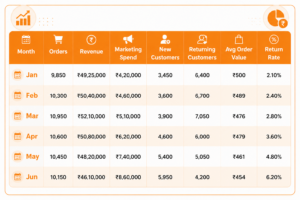
At first glance, the data doesn’t look alarming. Orders are relatively stable. Marketing spend is increasing. Customer acquisition is increasing. Yet revenue is steadily falling.
This is exactly the kind of business problem where AI excels—not because it magically knows the answer, but because it can rapidly connect patterns across multiple variables that humans often analyze separately.
👉 Read: Comic by Ankashram – Ask Tough Questions with Your Data Analyst
Step 1: Understanding the Business Before Using AI with Data analytics.
One of the biggest mistakes new analysts make is opening Power BI or Excel immediately.
Experienced analysts start with business questions. For FreshCart, the leadership team isn’t asking for another dashboard.
They need answers to questions such as:
- Why is revenue falling despite higher marketing spend?
- Are we acquiring the wrong customers?
- Has customer loyalty declined?
- Are returns impacting profitability?
- Which metrics should we prioritize?
- What actions will improve revenue?
Notice that none of these questions asks for a chart.
They ask for business decisions. This shift—from reporting numbers to solving problems—is exactly how AI is transforming data analytics.
Step 2: Traditional Analytics – The Manual Approach
Before AI, analysts manually calculated key business metrics.
Let’s calculate them ourselves.
Customer Retention Rate
Formula: Retention Rate = Returning Customers ÷ Total Customers
For January: 6,400 ÷ (6,400 + 3,450) = 64.97%
For June: 4,200 ÷ (4,200 + 5,950) = 41.38%
In just six months, customer retention has fallen by over 23 percentage points.
This is our first warning sign.
Customer Acquisition Cost (CAC)
Formula: Marketing Spend ÷ New Customers
January ₹4,20,000 ÷ 3,450 = ₹122 per customer
June ₹8,60,000 ÷ 5,950 = ₹145 per customer
FreshCart is spending more money to acquire each new customer.
Marketing efficiency is deteriorating.
Revenue Per Order
Formula: Revenue ÷ Orders
January ₹49,25,000 ÷ 9,850 = ₹500
June ₹46,10,000 ÷ 10,150 = ₹454
Customers are placing roughly the same number of orders but spending less.
Marketing Efficiency (ROAS)
Formula
Revenue ÷ Marketing Spend
January 49,25,000 ÷ 4,20,000 = 11.73
June 46,10,000 ÷ 8,60,000 = 5.36
FreshCart has almost doubled its marketing spend while its Return on Ad Spend has been cut by more than half. Already, without AI, we know the business is becoming less efficient.
But we still don’t know why.
Step 3: Introducing AI into the Workflow
Traditionally, an analyst would now build dozens of Pivot Tables, write SQL queries, create charts, and manually inspect every metric.
In 2026, the workflow looks different.
The analyst uploads the dataset into an AI assistant such as ChatGPT, Claude, or Microsoft Copilot and provides a structured prompt.
👉 Read: Comic by Ankashram The Ultimate Goal of Data Analytics
Prompt
“You are a Senior Business Analyst. Analyze this dataset. Identify anomalies, calculate missing KPIs, explain why revenue is falling, rank the top five business problems, and recommend actions supported by data.”
Within seconds, AI begins exploring relationships that would have taken hours to investigate manually.
Rather than replacing analytical thinking, AI accelerates the exploration phase, allowing analysts to spend more time validating insights and discussing business implications.
But! But! But! Before you jump to conclusions that,
– We do not need tool knowledge, it is now a 10 mins job, let us check if the data is clean. Yes! AI can do this for you but you need to be aware to get it verified.
Step 4: AI Cleans the Dataset
So, Before analysis, AI checks the quality of the data.
It flags:
- Missing customer IDs.
- Duplicate order numbers.
- Inconsistent city names (Mumbai vs. Bombay).
- Negative revenue values from refund transactions.
- Missing marketing campaign labels.
- Suspicious spikes in return rates.
Instead of manually reviewing thousands of rows, analysts approve AI-generated suggestions, reducing hours of repetitive work to a matter of minutes. The cleaner the data, the more trustworthy the analysis. This is why data preparation remains one of the most valuable applications of AI in analytics.
Step 5: AI Discovers Patterns Humans Miss
AI now evaluates relationships across every metric simultaneously.
Its first observation is striking:
- Marketing Spend increased from ₹4.2 lakh to ₹8.6 lakh (+105%).
- Revenue declined from ₹49.25 lakh to ₹46.10 lakh (-6%).
- Returning customers fell by 34%.
- Return rate nearly tripled.
- Average Order Value dropped by 9%.
Looking at these metrics individually tells only part of the story.
AI combines them into a business narrative:
FreshCart is replacing loyal, high-value customers with newly acquired customers who spend less, return more products, and cost more to acquire. Marketing investment is increasing, but customer lifetime value is decreasing.
This single insight is far more valuable than ten disconnected charts because it explains the underlying business dynamics.
Step 6: AI Performs Root Cause Analysis
AI doesn’t stop after identifying trends.
It keeps asking, “Why?”
Using customer reviews, support tickets, logistics data, and marketing campaign information, it identifies several contributing factors:
- Delivery delays increased by 22% in April.
- Mobile app checkout abandonment rose by 15%.
- Return rates for fresh produce doubled after a supplier change.
- First-time customers acquired through discount campaigns rarely placed a second order.
Instead of presenting isolated findings, AI connects operational, marketing, and customer data into a single explanation. This ability to synthesize multiple data sources is one of the biggest reasons AI is transforming modern analytics.
Step 7: AI Forecasts the Future
Executives don’t just care about the past. They want to know what happens next. Based on historical trends, AI forecasts the next three months.
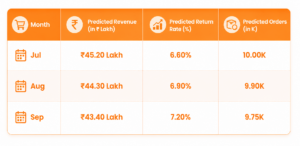
The forecast indicates that if FreshCart continues with the same strategy, revenue will continue to decline despite stable order volumes.
This insight enables proactive decision-making instead of reactive reporting.
Step 8: AI Recommends Business Actions
Perhaps the biggest transformation in 2026 is that AI no longer stops at reporting. It recommends actions.
For FreshCart, AI prioritizes the following initiatives:
- Reallocate part of the advertising budget toward existing customers through loyalty campaigns.
- Investigate the supplier responsible for increased product returns.
- Improve the mobile checkout experience to reduce abandonment.
- Personalize recommendations for repeat buyers to increase average order value.
- Reduce dependence on heavy acquisition discounts and focus on customer lifetime value.
Each recommendation is supported by data, making it easier for leadership teams to evaluate and implement.
Step 9: AI Builds Executive Dashboards
In the past, dashboards displayed numbers. In 2026, dashboards explain those numbers. A modern Power BI dashboard enhanced with AI includes:
- Revenue trends.
- Marketing efficiency.
- Customer retention.
- Return rates.
- Revenue forecasts.
- Automated executive summaries.
- AI-generated insights.
- Suggested business actions.
Instead of asking analysts to interpret charts during every meeting, executives receive contextual explanations directly within the dashboard. Dashboards evolve from reporting tools into decision-support systems.
Step 10: The Modern Analytics Tech Stack
The FreshCart analytics team uses different AI tools throughout the workflow.
| Stage | AI Tool | Purpose |
| Data Cleaning | ChatGPT / Copilot | Detect duplicates, missing values, anomalies |
| SQL Generation | Claude | Generate optimized SQL queries |
| Exploratory Analysis | Python + GitHub Copilot | Correlation analysis, clustering, feature engineering |
| Dashboarding | Power BI Copilot | Explain KPIs and generate narratives |
| Forecasting | Microsoft Fabric AI | Time-series predictions |
| Executive Reporting | Gemini | Summarize findings for leadership |
The important takeaway is that no single tool replaces the analyst. Instead, each tool accelerates a different stage of the analytics lifecycle.
Skills Every Data Analyst Needs in 2026
As AI automates repetitive tasks, the value of data professionals shifts toward higher-order thinking.Successful analysts in 2026 need to combine technical expertise with business understanding.
Key skills include:
- Excel for validating calculations and rapid analysis.
- SQL for extracting reliable datasets.
- Python for advanced analytics and automation.
- Power BI for interactive dashboards.
- Prompt engineering to communicate effectively with AI systems.
- Statistics to validate AI-generated insights.
- Data storytelling to translate analysis into business decisions.
- Domain knowledge to interpret results within business context.
The analysts who thrive will be those who can ask better questions, validate AI outputs, and communicate actionable recommendations.
Conclusion
Artificial Intelligence is not changing data analytics by eliminating analysts—it is changing how analysts work.
The FreshCart case study demonstrates that the modern analytics process is no longer a sequence of disconnected tasks. AI accelerates data preparation, uncovers hidden relationships, forecasts future outcomes, generates business narratives, and recommends actions, allowing analysts to focus on strategy rather than repetitive work.
The future of data analytics belongs to professionals who combine AI with critical thinking, statistical reasoning, and business context. Organizations that embrace this partnership will move beyond reporting what happened and toward understanding why it happened, predicting what will happen next, and deciding what to do about it.
In 2026, the competitive advantage is no longer having more data. It is having the ability to transform that data into confident, timely, and intelligent decisions—and AI has become the catalyst that makes that transformation possible.
Frequently Asked Questions (FAQ)
Q1. Is AI replacing data analysts in 2026?
No. AI automates repetitive tasks such as data cleaning, report generation, and exploratory analysis. Analysts remain essential for framing business problems, validating insights, and making strategic decisions.
Q2.What are the biggest benefits of AI in data analytics?
AI speeds up data preparation, identifies hidden patterns, improves forecasting, generates natural-language explanations, and recommends business actions, helping organizations make faster and better decisions.
Q3.Which AI tools are commonly used for data analytics?
Teams commonly use ChatGPT, Claude, Microsoft Copilot, GitHub Copilot, Power BI Copilot, Microsoft Fabric AI, Gemini, and Python-based AI libraries, depending on the stage of the analytics workflow.
Q4.What skills should aspiring data analysts learn in 2026?
A strong foundation in Excel, SQL, Python, Power BI, statistics, prompt engineering, and data storytelling—combined with business acumen—will be essential for succeeding in AI-powered analytics.