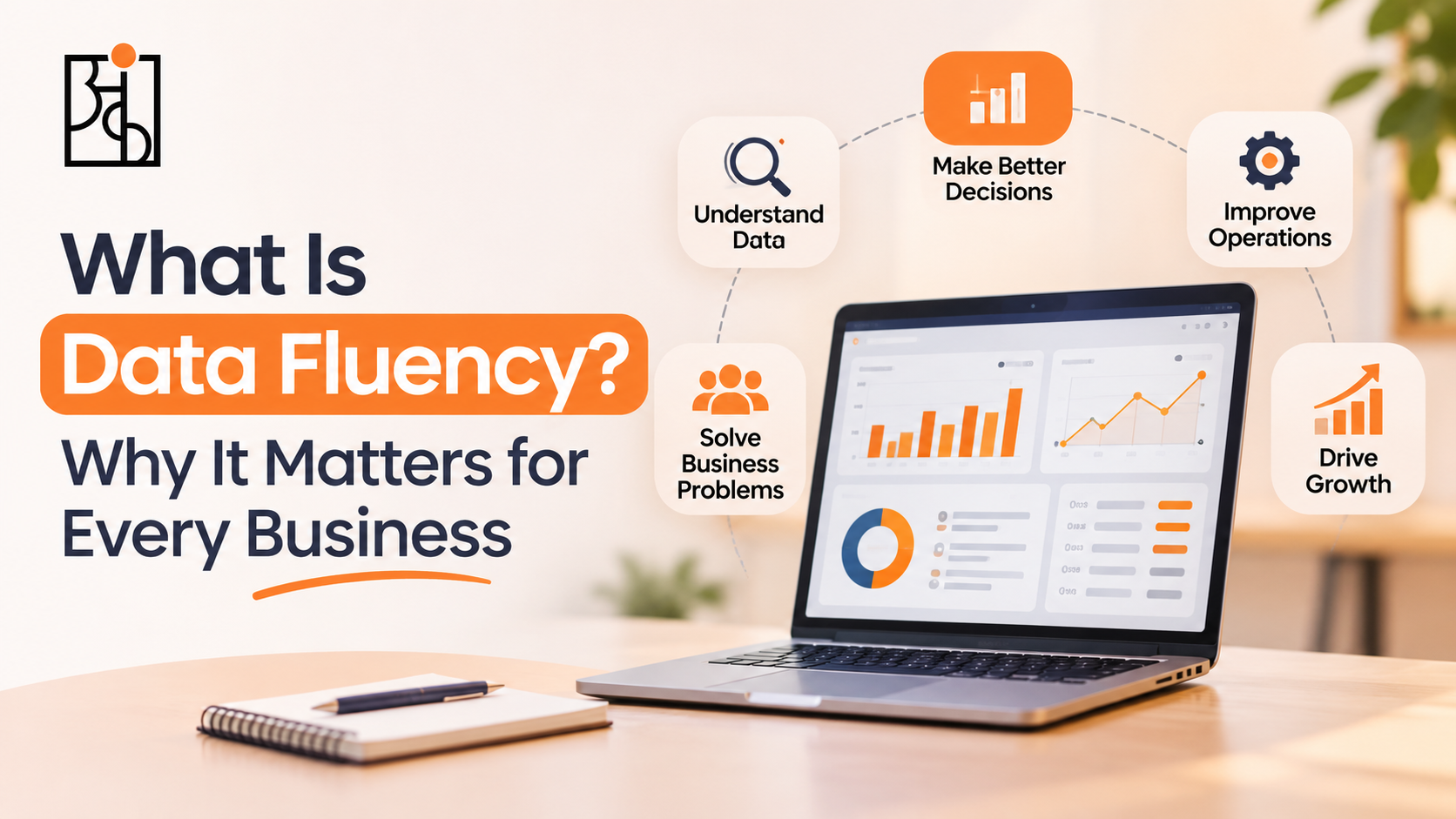
What Is Data Fluency? Why It Matters for Every Business
Imagine you’re in a meeting. Someone shows a slide and says “the data shows we’re seeing higher returns”. A few people nod. One person looks confused but doesn’t say anything. Another person is already considering their next steps. However, nobody has asked what “higher returns” mean, when and which product.
Table of Contents
Nothing particularly out of the ordinary has happened, but everyone in the room has access to data. Only a few of them are comfortable using it. This is where data fluency comes in.
What Is Data Fluency?
Simply put. Imagine a tourist that has a phrasebook. They can order a cup of coffee, ask for directions to the station and understand someone who is talking slowly. But as soon as they move on, they’re lost. A fluent person doesn’t have to think about grammar at all. They can understand jokes, recognise when someone is being vague and challenge them. They can then pivot the conversation and put complex things into simple language.
Data fluency is just this, but with numbers. A data fluent person can interpret a chart but also challenge it. They know what an average can hide and what a trend lacks. They can identify if a number looks odd, before it has been proven. They can also explain their findings to someone who doesn’t really care about the methodology and want to know what to do next.
Please note, there is no mention of software. Being data fluent does not mean you know SQL or Python. Whilst these can help, they are just nice pens that won’t do the writing for you.
Data Fluency Vs Data Literacy Vs Data Expertise
These 3 terms often get confused so it’s important to understand the difference.
- Data literacy – Knowing the basics. You can read tables, interpret charts and understand what a percentage means.
- Data expertise – Statisticians, analysts and engineers who create the models and pipelines.
- Data fluency – Falling in between the two. This is arguably the most important term to understand as it relates to how you can use data in your everyday work. A sales manager will know whether a spike is due to seasonality. A finance lead will know why 2 reports don’t match up. A marketer will know that they will adapt their campaign based on what they have seen in the numbers. Most organisations will have a few experts but lots of data literate people. It’s the data fluency that’s lacking and will be scattered throughout the decision making departments.
- What Is It In Practice?-It helps to give some examples They will always ask the question “Compared to what?”. A single number is not information. They can identify when something looks too good. If something confirms exactly what they hoped for, they’ll double check. They know the difference between correlation and causation and will call it out. They are not afraid to say “I don’t understand this chart”. This is a key point. In many workplaces it can be perceived as risky to admit you don’t get something so people will just nod along. This will impact their decision making. They know when data isn’t the right solution. Sometimes the sample size is too small, the question is too vague or the metric can’t be measured. They can point this out without feeling silly. They can simplify. They can take a list of findings and put them into 2 simple sentences, with a recommendation. None of these require technical knowledge. These are just habits and can be learnt.
Why It Matters To All Businesses
You may think this is just for tech companies or large enterprises with analytics teams. It’s not! Even small manufacturers, retailers, schools, clinics and logistics businesses will produce data and make decisions based on data.
Here’s why it matters.
Decisions are made with less drama. People can interpret the evidence for themselves so the meeting won’t be dominated by the most confident person. The debate will centre around what they can see and what they can’t be sure of.
Fewer costly mistakes. If you make a mistake with a number it can be costly. Most mistakes won’t be picked up by tools but by someone saying “this doesn’t look right”. The more people in your organisation that are data fluent, the fewer confident mistakes will be made.
Improved communication between departments. Often sales, operations, finance and HR don’t communicate well as they all have their own ways of defining and measuring. With a basic level of data fluency across the business, issues will be picked up earlier.
Analysts will be more useful. If the people they are supporting can ask insightful questions they will get the best out of them. If they can’t, they will be spending half their time creating reports nobody will look at and half their time explaining what a chart shows.
AI will be usable. This is becoming more apparent every month. Whilst AI tools can provide an answer in seconds, they will be very confident whether they are right or wrong. Someone will still need to know what to ask, verify what they are given and whether it fits the issue. Without data fluency, your business will be relying on confident outputs that they can’t assess. This is riskier than having no tool at all.
Signs Your Business May Not Be Data Fluent
Most organisations won’t realise they lack data fluency until they look for it. Here are a few clues. Everyone is proud of their dashboard but nobody looks at it. 2 teams have different numbers for the same thing. The meeting turns into an argument about whose spreadsheet is right. Data is used to back up decisions that have already been made. People are hesitant to challenge the chart, particularly if it is from someone senior or a nice tool. Every data question goes to the same 1 or 2 people. They are constantly busy. Nobody can really explain how a key metric is defined If 3-4 of these apply to you, don’t panic! This is where most organisations start. There is definitely room for improvement.
How To Improve Data Fluency (Without Creating Analysts)
Data fluency isn’t created by giving people a long course to do. Like learning a language, it’s done by using it, having something to gain from it and doing it in small chunks. A few things tend to help.
Ask questions. Teach people how to turn a vague concern into a question. For example, “Sales feel off” becomes “Did it drop in all regions and was it before/after the price change?”. This one skill will help with everything else.
Use your own data. Whilst generic examples can help with understanding concepts, using real issues will help create habits. Doing a short session using a messy spreadsheet from within the business will help more than a nice case study.
Define metrics. Simply writing down what your key metrics mean and who owns them will prevent a huge amount of arguments.
Be open to being confused. If leaders are asking basic questions, others will follow suit. Asking “What does this axis start at?” is a perfectly valid question for a CEO to ask.
Keep it interactive and short. People will remember what they have done, rather than what they have been told. Doing quizzes, finding flaws and live examples will keep people engaged. Involve everyone.
If it’s only one department that is data fluent then it won’t affect how the business thinks. This is the thinking behind our Think With Data programme at Ankashram. We’ve found that when people across the business learn to challenge assumptions and think through evidence together, data will no longer be something done by the analytics team. It will become part of how they work.
What Can You Do This Week?
If you don’t want to implement a full programme, start with one small change. Next time you are in a meeting, ask “Compared to what?” the first time a number is mentioned. Or ask someone to explain a chart in 2 simple sentences. Or write down how one metric is defined.
After doing this a few times, you’ll notice a few things. The atmosphere will be slightly sharper, the people who just nodded will speak up and decisions will be made based on something more solid.
This is what data fluency looks like. It’s not dramatic and doesn’t cost a lot. It’s a team that is now used to thinking with evidence and is one of the more valuable things to have within your business. Ankashram exists to help you achieve this.
Frequently Asked Question
Q1.What is data fluency?
Being comfortable using data in your everyday work. They can read, challenge and explain data in simple terms. Like learning a language, it’s not about knowing the rules but being comfortable using it. You won’t need a specialist to translate for you.
Q2.What is the difference between data literacy and data fluency?
Data literacy is knowing the basics. You can read and understand basic data such as charts and tables. Data fluency is knowing how to use data confidently to make real decisions. They can challenge what they can see and communicate their findings clearly.
Q3.Do you need technical skills such as coding or SQL?
No! Whilst they can help, data fluency is mostly about habits. They will know how to ask insightful questions, compare things, identify what a number may be hiding and explain their results simply. Many people will be very data fluent without ever writing a line of code.
Q4.Who in a business should be data fluent?
Everyone who makes or influences decisions. Almost everyone will have some influence. Managers, marketers, operations, finance and frontline staff will all use information to make decisions. Data fluency will help everyone.
Q5.How long will it take to improve data fluency within my team?
There is no set time frame. It will be improved by regularly practicing with real issues. Doing short sessions and keeping things simple with habits such as asking “Compared to what?” in meetings will usually show improvements quicker than expected.
Q6.How can Ankashram help businesses become data fluent?
We run bespoke, interactive workshops using our Think With Data approach. We help people across departments challenge assumptions, critically interpret evidence and make decisions together. Thinking is prioritised over tools.