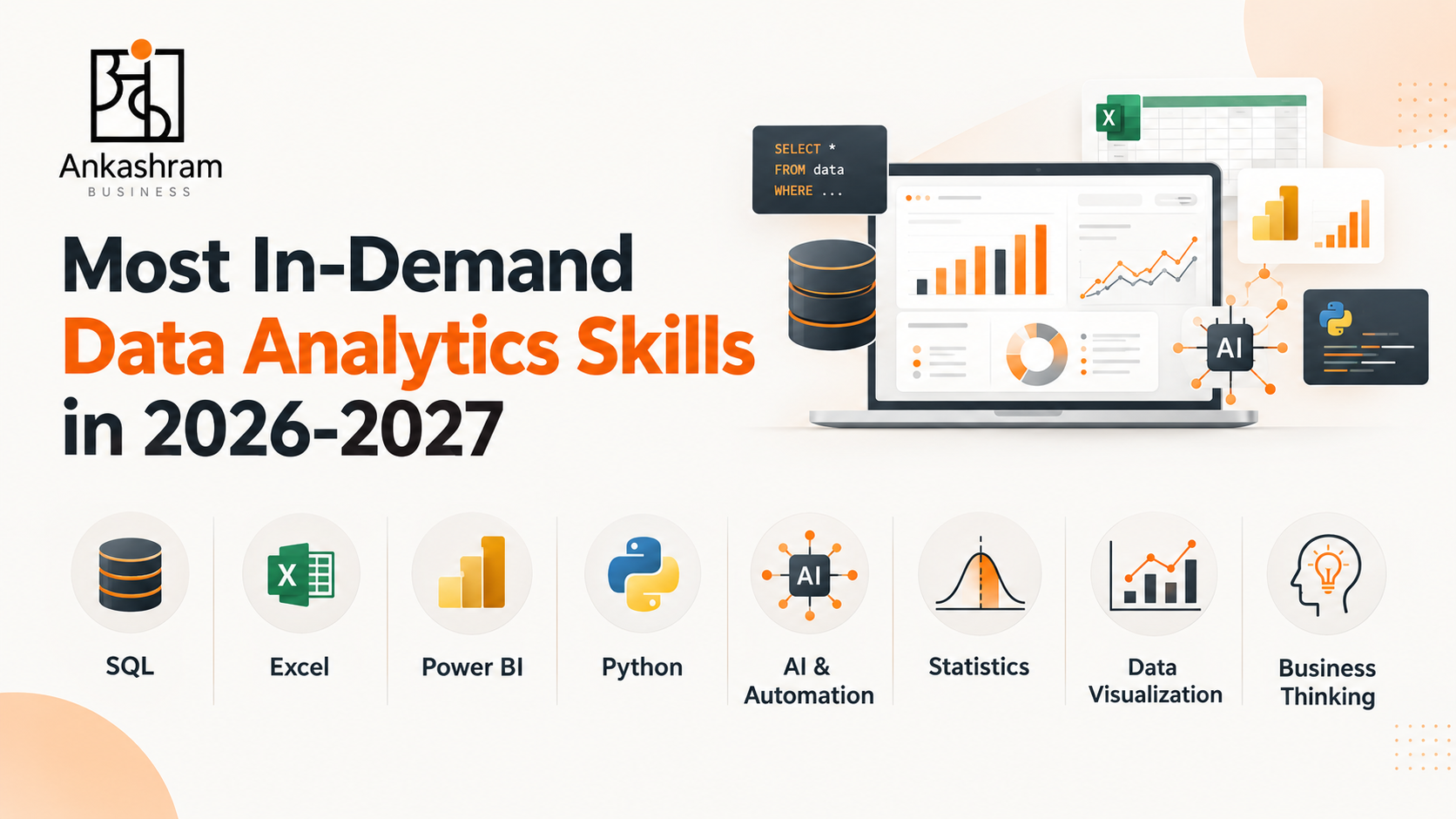
Most In-Demand Data Analytics Skills in 2026-2027
Every year around this time, someone asks what data analytics skills to learn next, and every year the honest answer shifts a little — not because the fundamentals change overnight, but because what recruiters actually screen for moves faster than most “top skills” listicles admit. This is something we think about a lot at Ankashram, since half the questions we get from readers boil down to “which of these am I actually supposed to prioritize?” So here’s an attempt to cut through the noise: not a list scraped off ten other blogs, but a real look at what’s shifting in this field heading into 2027, and why some of the “must-have” skills from three years ago are quietly becoming table stakes rather than differentiators.
Table of Contents
One pattern keeps showing up in these conversations: everyone’s fixated on tools, when the actual gap in most candidates is judgment. Let’s talk about both — the tools that genuinely matter right now, and the less glamorous stuff that’s quietly become the real differentiator.
SQL Isn’t Optional. It Never Was.

Get the obvious one out of the way first, because somehow it still needs saying. SQL remains the single most requested skill in data analyst job postings, full stop. Not Python, not any visualization tool — SQL. It’s the language of the database, and almost every company’s actual data lives in one, whether that’s PostgreSQL, MySQL, Snowflake, or BigQuery.
What’s changed isn’t whether you need SQL. It’s how deep you need to go. Basic SELECT statements and simple joins used to be enough to pass a screening round. Now interviewers are testing window functions, CTEs, and query optimization — because companies have gotten tired of hiring people who can write a query that technically works but takes four minutes to run on a table with ten million rows. If you’re prepping for interviews in 2026, spend real time on window functions specifically. RANK, LAG, LEAD, running totals — these come up constantly, and a surprising number of candidates freeze the moment a question requires one.
Python Has Quietly Become Non-Negotiable

For a long time, you could build a decent data analyst career on Excel and SQL alone. That door hasn’t fully closed, but it’s closing. Python — specifically pandas, along with basic familiarity with NumPy and matplotlib or seaborn — has moved from “nice to have” to something most mid-tier and senior analyst roles genuinely expect.
Why the shift? Mostly automation. Companies don’t want an analyst manually refreshing the same Excel report every Monday morning. They want someone who can write a script that pulls the data, cleans it, and spits out the report on its own. That’s a Python job, not an Excel job. Honest advice if you’re stuck choosing between the two: learn just enough Python to automate one piece of your own repetitive work. That’s usually the fastest way to make it stick — you feel the payoff almost immediately.
Data Visualization Tools (But the Bar Has Moved)
Power BI and Tableau still dominate job listings, and that’s not changing anytime soon. But here’s what’s different now: knowing how to drag a field into a chart isn’t impressive anymore. Everyone can technically build a bar chart. What separates candidates is whether they understand why one chart type tells the story better than another, and whether their dashboards actually make sense to a non-technical stakeholder at 9am on a Monday, half paying attention.
DAX — the formula language behind Power BI — is also becoming a real differentiator. A lot of analysts learn to drag-and-drop and never touch DAX beyond copy-pasted forum formulas. Anyone who can write their own measures, ones that handle time intelligence or complex filtering, is already ahead of a large chunk of the applicant pool.
Statistics: The Skill Everyone Underrates Until an Interview Humbles Them

This one deserves more attention than it gets. Plenty of self-taught analysts sprint straight to tools and skip statistics almost entirely, and it shows the second someone gets asked to explain correlation versus causation, or what a p-value actually means in plain terms — not the textbook definition, the “so what does this mean for our decision” version.
You don’t need a stats degree. But working comfort with hypothesis testing, distributions, regression basics, and increasingly A/B testing methodology matters, since so much of modern business decision-making runs on experiments now. Companies want analysts who can tell them whether a result is genuinely significant or just noise that happened to look good in a weekly report. That distinction, weirdly, is where a lot of “data-driven” decisions quietly go wrong.
AI Literacy and Prompt Engineering: Yes, It’s Real, and No, It’s Not a Fad
“Prompt engineering” felt like a buzzword dressed up as a job title for a while. But heading into 2026 and 2027, something’s genuinely shifted. Analysts are now expected to use AI tools to speed up their own workflow — generating first-draft SQL, summarizing large datasets, drafting documentation, even catching errors in their own work by asking an AI to sanity-check the logic.
This isn’t about becoming an AI specialist. It’s closer to what Excel was in the 2000s — a tool so baked into daily work that not knowing it well enough starts to actively slow you down. The analysts who’ll struggle here aren’t the ones without AI skills; they’re the ones who never learned to verify AI output critically, and end up shipping a confidently wrong number because a chatbot said so. It’s one area where Ankashram’s own coverage keeps expanding, mostly because the tools themselves keep shifting faster than almost anything else in this field.
Data Cleaning: Unglamorous, Constant, and Still Underrated

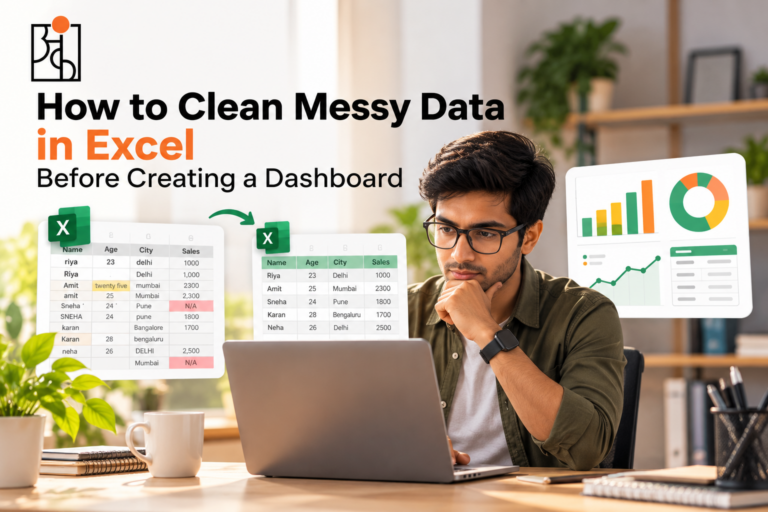
Nobody puts “I’m really good at cleaning messy data” on a resume with any excitement, but ask any working analyst what actually eats most of their week and the answer is almost always some version of this. Real-world data is messy — duplicates, inconsistent formatting, missing values, dates stored as text for reasons nobody can explain.
Recruiters are testing this more directly now, sometimes handing candidates an intentionally messy dataset just to watch how they think through it. Anyone who’s only ever practiced on pre-cleaned Kaggle datasets is missing a big chunk of what the job actually looks like day to day.
Data Storytelling and Communication (The Skill Tools Can’t Teach)
Here’s an uncomfortable truth: a technically brilliant analysis that nobody understands is functionally useless. Sharp, technically gifted analysts get passed over for promotion all the time because they can’t explain their findings to a VP without drowning them in jargon and seventeen unnecessary charts.
Data storytelling — taking a complex finding and turning it into a clear, three-sentence takeaway a busy executive can actually act on — is one of the clearest differentiators between a good analyst and a great one. It’s not fluffy soft-skill talk, either. It’s a specific, learnable craft: knowing what to leave out, which single number actually matters, and how to frame a recommendation instead of dumping a wall of data and hoping someone draws the right conclusion.
Business Acumen: Understanding the “Why” Behind the Numbers
A skill that rarely shows up on formal skill-tracking platforms but comes up constantly in hiring conversations is basic business understanding. An analyst who knows how the company actually makes money — what levers matter, what a 2% churn increase really costs, why marketing cares about one metric over another — produces fundamentally more useful work than someone purely technically skilled but operating in a vacuum.
It’s part of why career-switchers from non-technical backgrounds sometimes outperform people with more formal data training. Someone who spent three years in retail operations before switching into analytics often has a sharper instinct for which numbers matter than someone who’s only ever touched abstract datasets in a classroom.
Data Governance, Privacy, and Ethics — Quietly Becoming Mandatory
With regulations tightening globally and companies facing real consequences for mishandling data, understanding the basics of data privacy and governance isn’t a niche specialization anymore. Analysts increasingly need at least a working knowledge of how data should and shouldn’t be used, stored, and shared — especially anyone touching customer-level data in finance, healthcare, or anything personal.
Nobody needs to become a compliance expert. But knowing enough to flag a problem before it becomes a headline is turning into a baseline expectation.
Cloud Platforms: Increasingly Part of the Baseline
Snowflake, BigQuery, and to a lesser extent Databricks show up in job postings more and more, and not just for data engineers anymore. As more companies move their data infrastructure to the cloud, analysts who can comfortably query and work within these platforms — rather than only knowing how to pull a CSV into Excel — have a real edge. You don’t need to become a cloud architect. Just don’t freeze the first time someone asks for a query against a Snowflake warehouse instead of a local database.
So Where Should You Actually Start?
If all of this feels like a lot, that’s because it genuinely is — nobody masters ten skills at once, and trying to is usually how people burn out three weeks into a study plan. Get SQL and basic statistics solid first, since almost everything else builds on that foundation. Then add either Python or a visualization tool, whichever matches the role you’re aiming for. Layer in AI-tool literacy along the way, since it’s cheap to pick up and pays off almost immediately. Business acumen and communication develop more slowly and mostly come from actually doing the work, so there’s no need to “master” those before applying anywhere.
What’s worth resisting is the urge to chase every trending skill the moment a new listicle names it. The analysts who build solid careers tend to go deep on fundamentals first, then layer on the newer stuff once they’ve got something solid underneath it. Tools will keep shifting — that’s just how this field works. But solid SQL instincts, real statistical judgment, and the ability to explain findings clearly to someone who doesn’t care about the query logic behind them? Those don’t go out of style, whatever year it is.
If you’re looking to build these skills in a more structured way, explore Ankashram’s other data analytics resources — they go deeper into most of what’s covered here.
Frequently Asked Questions
Q1.Do I need to learn all of these skills before applying for a data analyst job?
No, and trying to would probably delay you unnecessarily. Get SQL and basic Excel solid, add some statistics, and you’re already in a position to apply for entry-level roles. The rest — Python, advanced visualization, cloud platforms — can come after you’ve landed something and figured out what your specific role actually needs.
Q2.Is Python more important than Excel now?
Not more important, just different. Excel still shows up constantly, especially at smaller companies or in roles heavy on reporting. Python matters more once you’re automating repetitive work or handling datasets too large for a spreadsheet to comfortably manage. Most working analysts end up using both.
Q3.How much statistics do I actually need to know?
Enough to explain hypothesis testing, understand what a p-value is telling you, and know the difference between correlation and causation without stumbling. You don’t need a graduate-level stats background — you need working comfort, not academic depth.
Q4.Will AI tools replace data analysts?
Not in any way that looks like analysts disappearing. What’s actually happening is that AI is replacing the slower parts of the job — first-draft queries, repetitive summaries, boilerplate documentation — which shifts the value toward people who can judge whether the AI’s output is actually right. Knowing how to use these tools well is becoming part of the job, not a threat to it.
Q5.Which skill should I prioritize first if I’m just starting out?
SQL, without much competition. It shows up in nearly every job posting, it’s the foundation a lot of other skills build on, and it’s one of the fastest skills to get genuinely comfortable with if you practice consistently.
Q6.Is a certification enough to get hired, or do I need a portfolio too?
A certification alone rarely gets someone hired on its own merit anymore — there are simply too many of them floating around. A small portfolio of real projects, even simple ones using public datasets, tends to matter more in interviews, because it gives you something concrete to actually talk through.