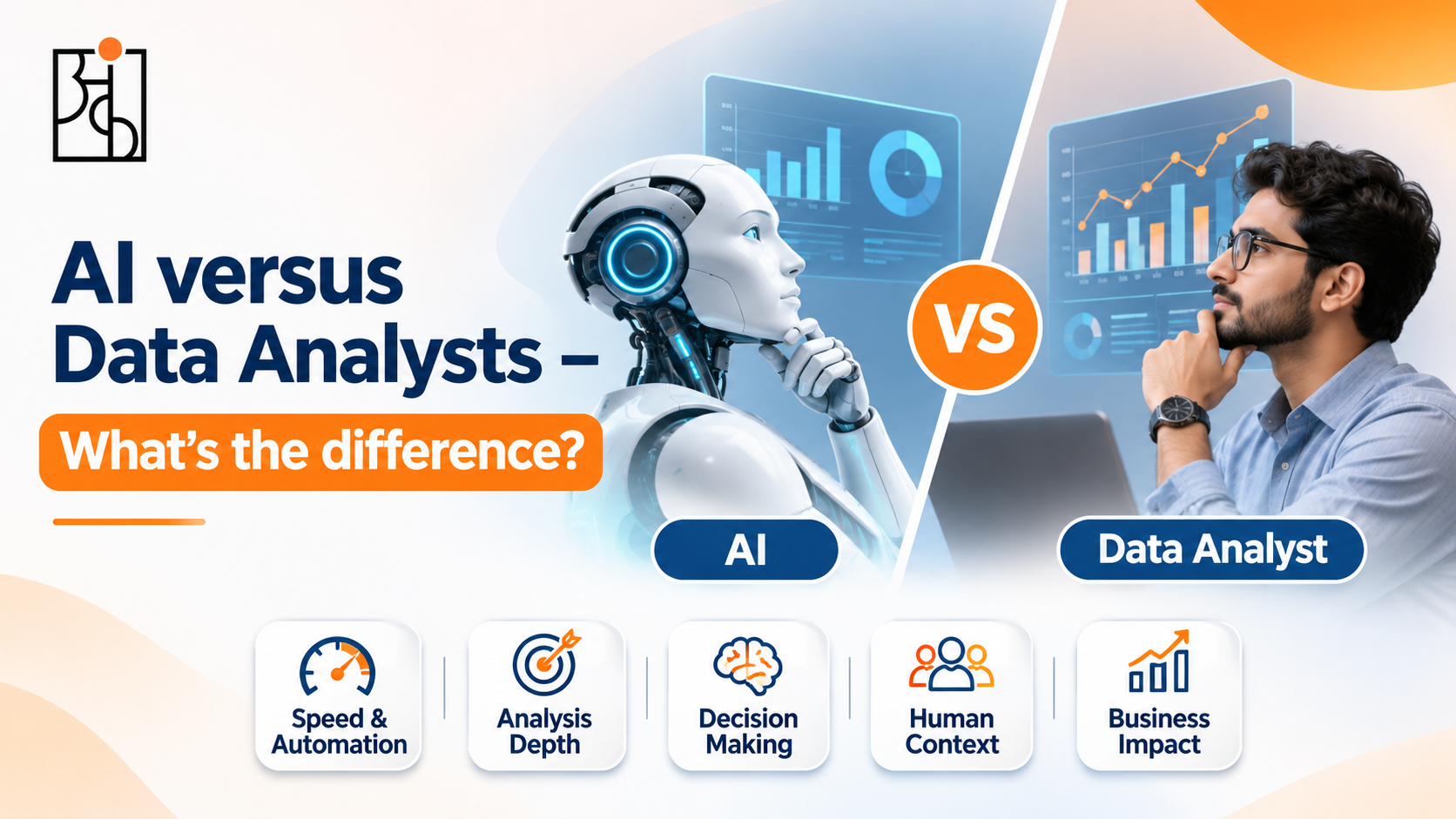
AI versus Data Analysts – What’s the difference?
With spreadsheets, answering questions in plain English and creating charts in seconds, many people are asking – are we really still going to need data analysts?
Table of Contents
Yes, however there are some interesting reasons why. By knowing the differences between an AI and a data analyst it will help you utilise both tools effectively.
What AI data tools can do
AI can do the data processing quickly. By uploading your data and asking an AI a clear question, many tools will be able to give you a summary, identify some simple trends, create formulas and simple charts. They can do well with repetitive data cleansing. They can also create code/SQL based on what you’re trying to achieve. They can also work 24/7 without getting bored of doing the same calculation for the 100th time.
Overall, an AI can give you a great initial insight into your data, providing quick summaries and making your day-to-day reporting easier.
Where humans still excel
However, an AI does not have any business insight. They won’t know why your sales dropped in March due to a large client delaying their contract. They won’t know what metric your leadership team are actually interested in this quarter. They won’t know if the trend identified is actually worth looking into or just a statistical anomaly. They’ll also have no idea about the political context.
A human data analyst can use their judgement to ask the right questions, pick up on issues where the numbers look right but the insight doesn’t feel right, and provide insights in plain language that your audience can understand. They will also be able to relate the information to decisions being made.
Context and judgement still reigns supreme in most important decisions.
Practical Differences
An AI will help with the processing and presentation of your data, whereas humans will excel with the interpretation and decision making. An AI can tell you that revenues have decreased by 12% in a particular region. A human analyst can tell you why this is important, what to look into further and what the team should do next.
An AI can provide you with 10 chart options, but a human can decide which 2 will provide actual value in your meeting. An AI can highlight an outlier, but a human can decide whether this is an error, an opportunity or something you can ignore.
Most of the time you’ll get the best results by using both. The AI can do the hard work and provide you with an initial draft. The human can then provide feedback, questions, context and recommendations.
Practical Skills
It’s no longer enough to know how to analyse data. You need to know how to use AI tools effectively without losing your judgement. You’ll need to be able to ask better questions. Check the numbers provided. Identify when the AI is providing technically correct answers that don’t provide any value. Relate the information back to your business issue. Programs like Think with Data at Ankashram focus on this. We aim to help professionals improve their data literacy, asking the right questions and making decisions using modern tools.
Those who only know how to ask the AI questions will hit a ceiling. However those who combine their domain knowledge, analytical skills and smart use of AI tools will continue to progress.
Common Misconceptions
Many feel that AI will completely replace analysts soon. However there is currently no evidence for this. AI is taking away a lot of the boring part of analysis meaning those with the judgement to interpret the results are becoming more valuable.
AI is not always accurate. Whilst they can often seem very confident with their answers they can lack context. They can also make up trends that look pretty but aren’t accurate. Anything feeding into a real decision will require a human.
Many feel that only technical people need to worry about this. However anyone using data to support decisions will benefit from knowing the pros and cons of AI tools.
How to Work Effectively
Be clear with the question you need answering. Use an AI to get an initial insight and carry out any day-to-day calculations. Carefully review the output. Ask additional questions. Confirm key numbers. Provide context to the business. Create a clear recommendation.
This will ensure you’re using the speed of the AI whilst maintaining quality decisions.
Our practical programmes focus on understanding the problem, analysing the data, testing the results and relating back to actions. Whilst the tools may change, the way of thinking remains useful.
Read More: How to Think Like a Data Analyst (Even If You’ve Never Touched a Spreadsheet
Frequently Asked Questions
Q1.Will AI replace data analysts?
No. Whilst an AI can provide great processing and summarisation, humans still have the edge with judgement, context and translating analysis into decisions. Roles are changing.
Q2.What should analysts be focusing on learning?
Being clear with the problem, reviewing the AI output, relating the numbers back to the business and presenting your findings clearly. Whilst technical tools are still important, judgement and presentation are becoming more important.
Q3.Are free AI tools accurate enough to use in business?
They can be useful for initial insights, but they are not always accurate. Always double check any important numbers.
Q4.How does Ankashram feel about AI?
We see AI as a practical tool to speed up your work. Programmes like Think with Data help professionals develop their core skills to analyse and make decisions, whilst using the AI tools effectively.
Q5.Do I still need to learn Excel/Power BI?
Yes! To get the best out of an AI tool you’ll need to understand the data behind it. Having judgement over the quality of the output is key. Spreadsheets and dashboards are still a very useful skill.
Q6.What is the main risk of over relying on AI?
Not double checking the answers, they can seem very confident. You’ll lose the habit of asking if it actually helps with the business decision.