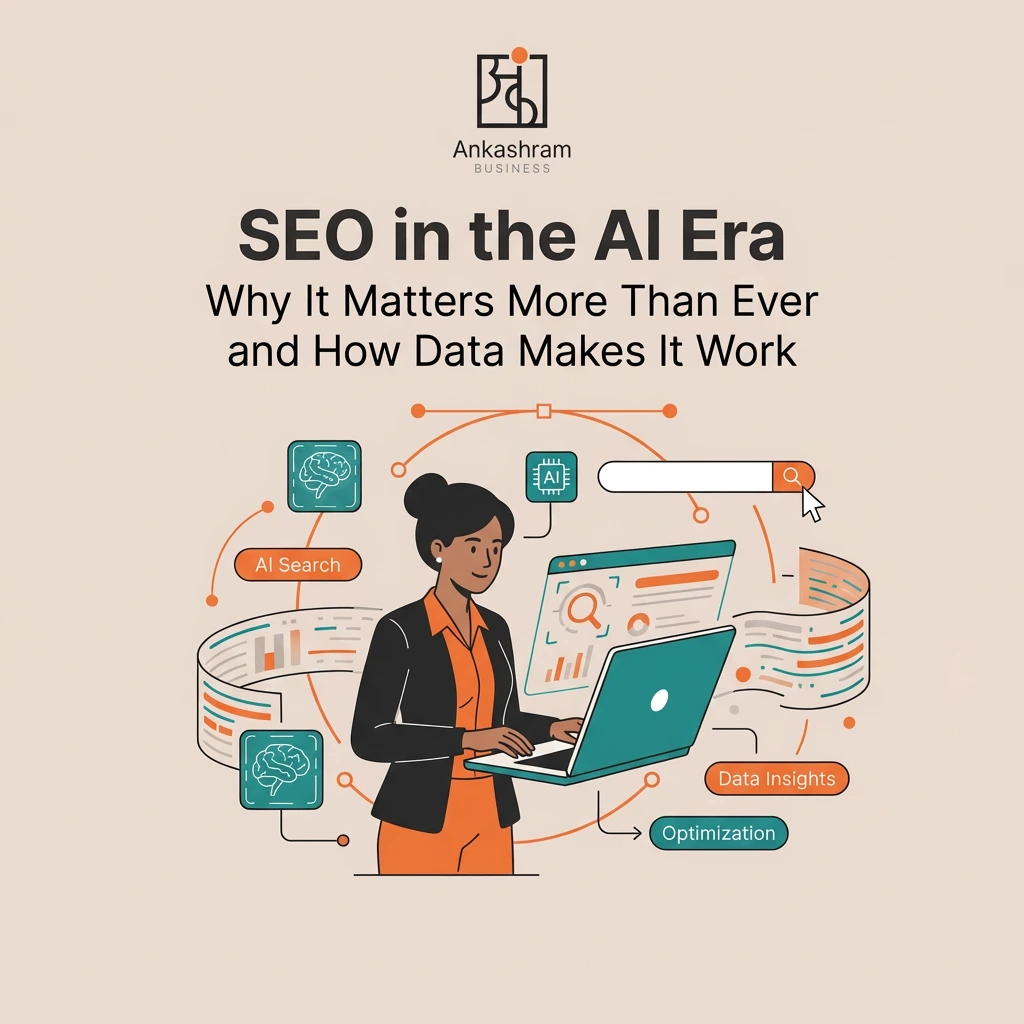
SEO in the AI Era: It Matters More Than Ever and Data Makes It Work
For many business leaders today, SEO feels like an outdated discipline. It is often associated with keyword stuffing, ranking games, and chasing Google’s ever-changing algorithm. In an era where AI tools can answer questions instantly, write content on demand, and summarize entire websites in seconds, it’s reasonable to ask: Does SEO still matter? And if it does, how should companies rethink it in the age of AI?
The short answer is this: SEO has not become less important — it has become more strategic. What has changed is what SEO optimizes for, how success is measured, and how deeply it depends on a company’s own data. Companies that understand this shift are gaining disproportionate visibility. Companies that ignore it are quietly disappearing from how modern users discover information.
To understand why, we need to first understand how search itself has changed.
How Search Has Changed in the AI Era
Search is no longer just a list of blue links. AI-driven systems now interpret user intent, synthesize answers, and often respond directly without sending the user to another website.
Whether it is Google’s AI Overviews, Bing’s AI answers, voice assistants, or conversational tools like ChatGPT, the user experience is increasingly answer-first, not link-first.
This does not mean users have stopped searching. In fact, search usage is growing. What has changed is where decisions are made. Earlier, the decision happened after clicking through multiple results. Now, decisions often happen inside the AI response itself.
From a business perspective, this creates a new reality:
If your brand, product, or expertise is not present in the AI’s understanding of a topic, you may never enter the consideration set at all. This is where modern SEO begins.
SEO Is No Longer About Ranking Pages — It’s About Being Understood
Traditional SEO focused heavily on keywords: what people type, how often they search, and how competitive a term is. While keywords still matter, AI systems do not rely on exact matches. They rely on semantic understanding — meaning, relationships, context, and authority.
In practical terms, this means AI asks questions such as:
-
Is this brand consistently associated with this topic?
-
Does this content clearly answer the user’s intent?
-
Is this information reliable, structured, and supported by data?
-
Has this source demonstrated expertise over time?
SEO in the AI era is therefore less about gaming algorithms and more about teaching machines who you are and what you are credible for.
This is where Generative Search Optimization (GSO) becomes relevant. GSO expands the idea of SEO beyond Google rankings to include how your brand appears across all search-like discovery systems, including AI assistants, voice search, app stores, and internal enterprise search engines.
Why AI Search Still Depends on SEO Foundations
A common misconception is that AI models “don’t need SEO” because they generate their own answers. In reality, AI systems are deeply dependent on structured, high-quality web content. They do not invent knowledge from nothing. They learn patterns from existing data, prioritize authoritative sources, and surface content that is well-organized and clearly explained.
When AI systems generate answers, they rely on:
-
Well-structured pages
-
Clear topic coverage
-
Consistent terminology
-
Strong signals of expertise and trust
-
Engagement signals that indicate usefulness
These are all traditional SEO principles — but applied at a higher level. If SEO disappears from your strategy, AI does not replace it. AI simply replaces you with competitors who invested in clarity, structure, and authority.
The Role of Company Data in Making SEO Work in the AI Era
This is where most companies underestimate the challenge. SEO today is no longer just a marketing activity. It is a data problem. AI-driven search systems reward companies that understand their audience deeply and reflect that understanding in their content. That understanding comes from data — not assumptions.
When a company captures and connects the right data, SEO stops being reactive and becomes predictive.
For example, behavioral data from your website shows what users actually care about, not what you think they care about. Search query data reveals how people phrase their problems in real language. Customer support logs expose recurring pain points that users rarely articulate in marketing surveys. Product usage data highlights which features create value and which ones confuse users.
When this data feeds into content creation, SEO becomes aligned with real user intent, which is exactly what AI systems are optimized to detect. Without this data, SEO, GEO or ASO teams are forced to guess. With it, they can design content ecosystems that machines and humans both understand.
What Companies Miss When They Ignore SEO in the AI Era
Choosing not to invest in modern SEO does not result in “neutral impact.” It creates compounding disadvantages.
- First, discoverability declines silently. You may still have a website, still run ads, still publish content — but AI systems will favor competitors whose content is easier to interpret and trust. Over time, your brand stops appearing in summaries, comparisons, and recommendations.
- Second, customer acquisition costs rise. As organic discovery weakens, paid channels take on more pressure. This is expensive and unstable, especially as ad ecosystems themselves become AI-driven and more competitive.
- Third, institutional knowledge is lost. SEO forces companies to document expertise, structure knowledge, and align teams around shared understanding. Without it, insights remain scattered across teams, tools, and individuals — inaccessible to both humans and machines.
- Finally, companies lose strategic control. When AI systems define your category without your input, your positioning is shaped by external narratives rather than your own data.
What SEO Looks Like When Done Right Today
Modern SEO is not a checklist. It is an ongoing process of alignment between user intent, business goals, and machine understanding. It starts with capturing meaningful data — not vanity metrics, but signals that reveal how users search, learn, decide, and convert. That data is then translated into content that answers real questions clearly and completely.
The content is structured so machines can parse it easily, but written so humans find it genuinely helpful. Over time, this content ecosystem builds authority, not because it chases trends, but because it reflects real expertise. Measurement also evolves. Rankings matter, but so does presence in AI summaries, brand mentions in conversational responses, and visibility across non-traditional search surfaces.
In this model, SEO becomes less about “traffic” and more about strategic visibility.
Why the AI Era Actually Makes SEO Non-Negotiable
Ironically, the rise of AI makes SEO more important, not less. When information becomes abundant and instantly accessible, trust and clarity become the differentiators. SEO is the discipline that builds both at scale. AI systems reward brands that are consistent, authoritative, and useful over time. These qualities cannot be faked with one-off campaigns or shortcuts. They are the result of sustained data-driven optimization.
For a company reluctant to try SEO, the real risk is not wasted effort — it is missed opportunity. The companies shaping AI-driven discovery today are defining the categories of tomorrow. Those who wait will have to work much harder just to be noticed.
Final Thought
SEO in the AI era is no longer about chasing algorithms. It is about earning understanding — from machines and from people. Companies that capture the right data, connect insights across teams, and invest in structured, intent-driven content will not just survive AI-driven search. They will lead it. Those that ignore SEO are not opting out of the system. They are simply choosing not to be represented in it.