What My 21K Taught Me About Data Analytics
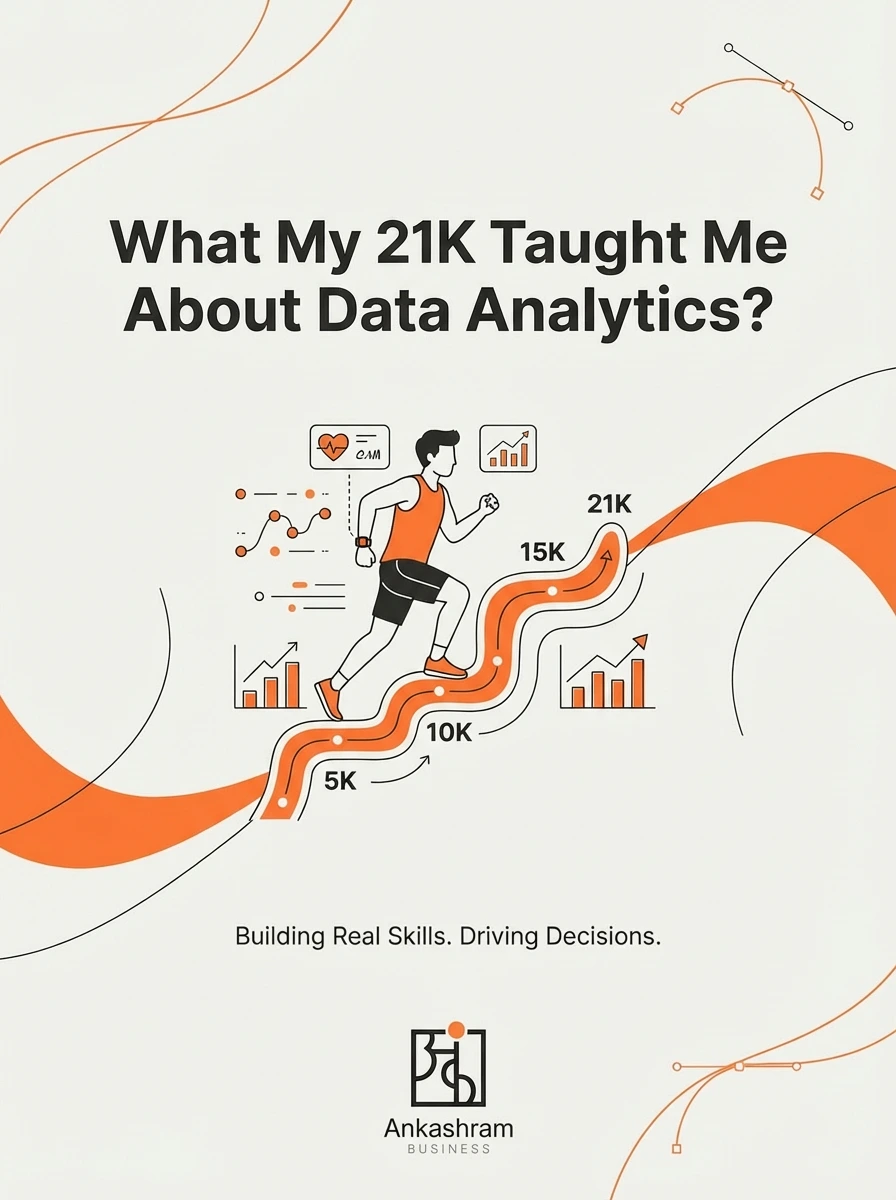
It all began with a personal goal. I wanted to run a half marathon—21 kilometers of effort, discipline, and strategy. But more than anything else, it became a masterclass in data. Not the data of balance sheets or dashboards, but of heart rates and stride lengths. And through that journey, it became crystal clear to me: if we don’t track what truly matters, we don’t improve. And if we don’t improve, we stagnate—be it in running or in business.
Three months before race day, I set out on a disciplined training schedule. Each day was carefully planned: easy runs, tempo runs, long-distance days, strength training. But the real transformation didn’t come from just lacing up my shoes every morning. It came from what I did afterward. I monitored every single metric I could: my average pace, the distance covered, cadence, elevation, recovery time, even the weather patterns of the days I felt sluggish. I analyzed how my heart rate behaved on hill sprints versus flat loops. I studied how hydration influenced recovery. All of it mattered.
These numbers weren’t just vanity metrics. They were directional signals. When my average pace dropped despite longer training runs, I knew fatigue was setting in. When my heart rate stayed high during recovery runs, I knew something was off—perhaps stress or sleep. Each metric was a lens, offering clarity in a fog of assumptions.
Why did I take this approach? Because I had a goal. And when you have a set target, the only way to get there efficiently is to know exactly what influences the outcome—and how you are progressing.
The beauty of running today is that technology makes this streamlined. Wearable gadgets—smartwatches, fitness trackers, running pods—capture every ounce of data and turn it into dashboards that don’t just inform, they guide. After each run, I didn’t have to pore over pages of handwritten logs or cobble together spreadsheets. My watch showed me—graphically, beautifully—what was working and what needed work. The data wasn’t just available. It was consumable.
And here’s where the analogy sharpens. What if I told you that many businesses today still function like runners from the 1990s? They’re ambitious, sure. They put in effort. But they record performance in ledgers and registers—or worse, in silos. They track sales here, website traffic there, customer service complaints somewhere else entirely. Some use Excel sheets, some rely on periodic reports. Most lack a centralized system or a combined view of reality. They are essentially runners training for a marathon but refusing to wear a fitness tracker, relying instead on memory and guesswork.
In business, just as in running, having a goal is only the first step. The real test is: are you measuring the right things? And is that measurement accessible, actionable, and aggregated?
Businesses today are surrounded by data—volumes of it. Every click, every transaction, every customer inquiry generates a digital footprint. But data without structure is noise. Data without integration is a puzzle with missing pieces. And data without analysis is simply wasted opportunity.
Consider this: a study by McKinsey found that data-driven organizations are 23 times more likely to acquire customers, 6 times as likely to retain them, and 19 times as likely to be profitable as a result. Yet, according to Forrester, up to 73% of company data goes unused for analytics. That’s like running 73% of your training blindfolded and expecting to beat your personal best.
The reasons for this gap are many. For one, many organizations still treat data as a byproduct of operations, not the engine of decisions. Data exists, yes—but scattered. Marketing has their own tools. Sales works in their CRM. Finance runs on an ERP. These systems often don’t talk to each other. Even when they do, the language—formats, metrics, definitions—is inconsistent. The result? Fragmentation. One department says business is up; another says it’s down. Both may be right, but without a unified view, leadership is stuck in confusion.
The next issue is interpretation. Just like my watch gave me visual dashboards and clear alerts, businesses need data that is digestible. A spreadsheet filled with raw numbers may contain gold, but only analysts can mine it. If frontline teams, product managers, marketers, and decision-makers can’t understand the data, it serves little purpose.
This is where data analytics transforms from being a backend function to a front-line strategy. Let’s take a retail example. A brand sees that its website traffic has gone up 40% month-on-month. Good news? Not necessarily. Unless that increase is mapped against bounce rate, conversion, and customer acquisition cost, it’s just volume, not value. But when you layer the data—connect source of traffic, product views, cart abandonment, time of day, discount codes used—you start seeing patterns. Maybe Instagram reels are driving traffic, but conversions are only coming from Google Ads. That insight can immediately reshape strategy.
Now think broader. In a manufacturing company, analyzing production line data alongside maintenance logs and worker shifts might reveal that downtime always spikes on Mondays—not because of machine faults, but due to crew fatigue. That insight can change scheduling.
In healthcare, analyzing patient symptom data alongside environmental parameters might predict spikes in seasonal illnesses, allowing better resource allocation. In logistics, combining fuel consumption with route planning and delivery windows might reveal optimal delivery clusters.
But none of this is possible without a robust data architecture. You can’t analyze what you can’t see. And you can’t see clearly if your data is scattered, unstructured, or inconsistent.
So how can businesses begin this journey of structured, meaningful data analytics?
First, assess the maturity of your data ecosystem. Ask yourself:
-
Is our data structured or unstructured?
-
Do we have a centralized data storage solution—a data lake or a warehouse?
-
Are different teams aligned on metric definitions? Is ‘conversion’ defined the same way by marketing and sales?
-
Do we have data visualization tools in place?
-
Are decision-makers trained to consume dashboards, not just reports?
If the answers to these questions are ‘no’ or ‘not sure’, that’s where the real work begins. Fortunately, you don’t need to overhaul everything overnight.
Start with consolidation. Identify critical data sources—CRM, website, POS, customer feedback forms. Integrate them into a centralized repository. Cloud solutions like Google BigQuery, Snowflake, or AWS Redshift offer scalable, secure options.
Next, clean the data. A dashboard is only as good as the integrity of the data beneath it. Standardize naming conventions, time zones, categories. Resolve duplications.
Then comes modeling. Structure the data into themes—sales, marketing, product, finance—so that reports and dashboards can be built with context. For instance, a marketing dashboard should show not just ad spends, but ROI, CAC, and LTV. Invest in visualization. Use tools like Power BI, Tableau, or Looker. But more importantly, train your teams to interpret them. A chart that no one understands is just decoration.
Finally, make analytics a part of daily decisions. Just as a runner checks metrics post every run, a business should have daily, weekly, monthly cadences of analysis. The best teams use data not reactively but proactively—to plan, experiment, and evolve.
What’s truly exciting is that even small improvements here can unlock huge impact. A slight shift in pricing strategy, informed by customer data, can grow margins. A better understanding of sales funnel leaks can increase closure rates. A sharper view of supply chain inefficiencies can cut down delivery times. We often glorify instincts in business—gut feel, leadership hunches. But even the sharpest instinct needs validation. Data doesn’t replace decision-making. It sharpens it. It gives direction to intuition, clarity to vision, and accountability to action.
As for me, I ran that 21K in record time—not because I was fitter than before, but because I was more informed. I didn’t guess my progress. I didn’t overtrain or underfuel. I simply tracked the right things and acted on them. It wasn’t magic. It was method. And isn’t that what every business needs? Not more effort, but smarter effort. Not more data, but better use of it.
Because in the end, success—whether on the road or in the boardroom—isn’t about how fast you start. It’s about how wisely you pace yourself, and how relentlessly you improve.